
LUNDI 21 SEPTEMBRE 2026 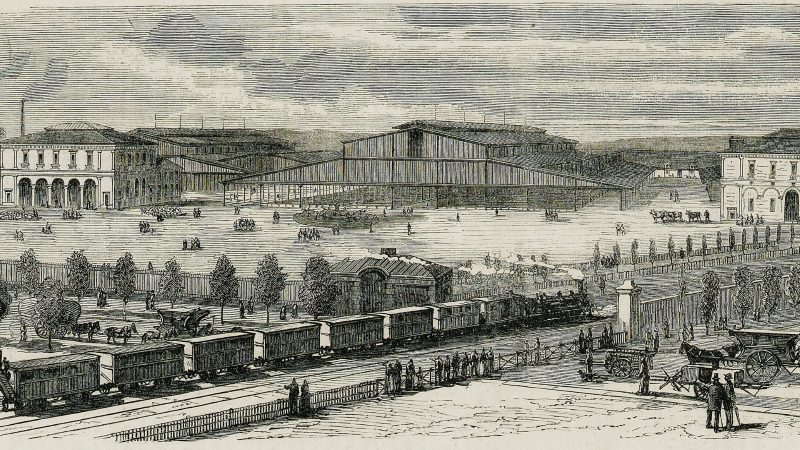
A Lost Masterpiece of Baltard’s Paris Returns to the Market
O n the occasion of the European Heritage Days, the 17th edition of Paris Mon Amour, organised by Lucien Paris at Hôtel Drouot, will bring back to light a forgotten monument of Second Empire Paris: the vast iron structure of the Halle aux Moutons at La Villette, inaugurated in 1867 in the wake of Victor Baltard.
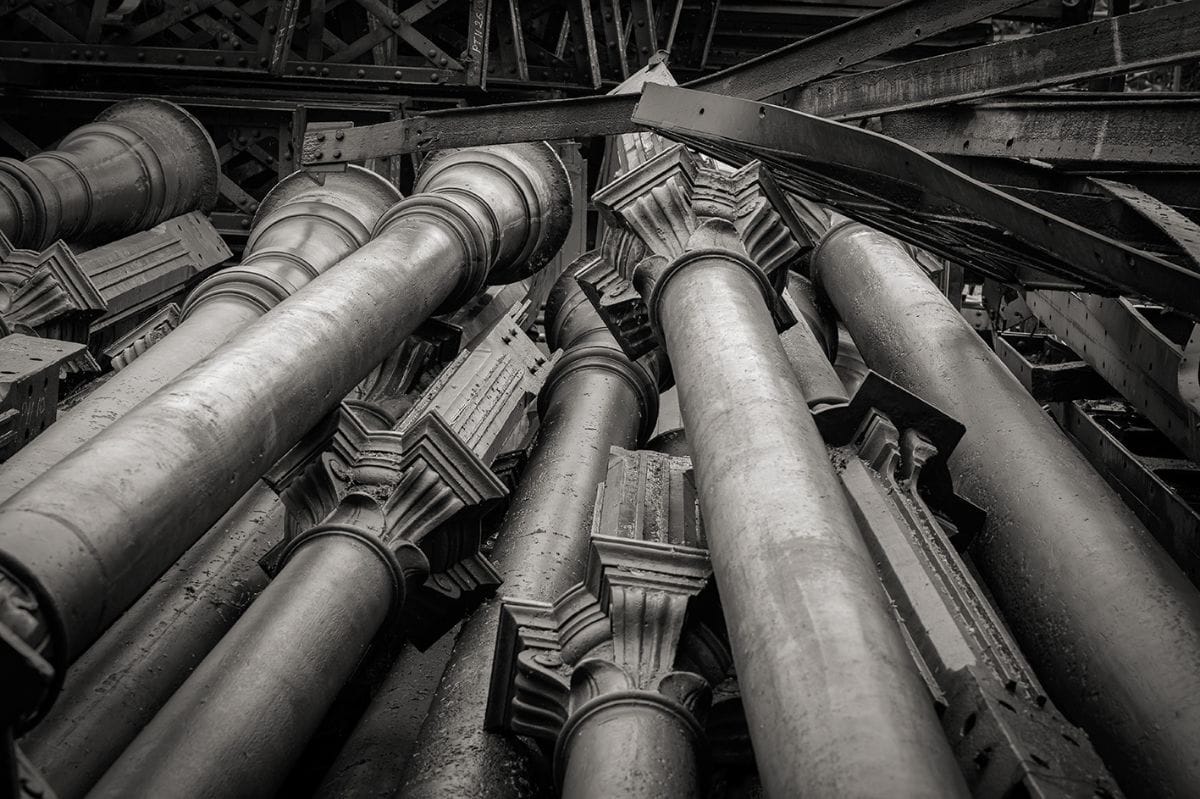
Dismantled following the demolition of the market hall in the 1980s, the structure was carefully preserved and survives today in 672 separate elements, covering almost 5,800 sq m. It is now coming to auction with an estimate of around €2 million.
Second Empire Paris: the birth of a new architectural language
Under Napoleon III, Paris was transformed on an unprecedented scale. With the Emperor and Prefect Haussmann driving the modernisation of the capital, the city expanded and its infrastructure was reshaped. Iron architecture came to embody a new age of technological progress, urban ambition and modernity.
These developments built on experiments that had begun earlier in the 19th century, notably in Paris’s covered passages and shopping arcades, from the Passage des Panoramas to the Galerie Vivienne and Passage Jouffroy. There, cast iron, glass and natural light created entirely new kinds of urban spaces. The same principles would soon be applied on a far larger scale - in railway stations, market halls and the pavilions of the Universal Exhibitions - as architects sought to create lighter structures, more open spaces and a new kind of monumentality through the use of metal.

Following in Victor Baltard’s footsteps
The Halle aux Moutons at La Villette was inaugurated on 21 October 1867, the year of the Universal Exhibition. Its origins lay in the plans of Victor Baltard, one of the defining figures of 19th-century Parisian architecture. As Architect of the City of Paris and designer of Les Halles Centrales, Baltard was at the forefront of this new approach to urban architecture. In 1859, the City of Paris also commissioned him to oversee the planning of new livestock markets and slaughterhouses to replace the city’s existing facilities.
At La Villette, Baltard applied many of the principles behind Les Halles Centrales: modular construction, repeated structural elements, carefully planned circulation and an extensive use of iron to meet the demands of a vast industrial site. The construction of the market halls was subsequently entrusted to Jules de Mérindol, a pupil of Baltard, with the assistance of Louis-Adolphe Janvier.
Together, they created one of the most ambitious industrial complexes of modern Paris. Seen from the city’s fortifications and railway lines, the halls formed a vast landscape of iron and glass, ranking among the most striking sights of industrial Paris.
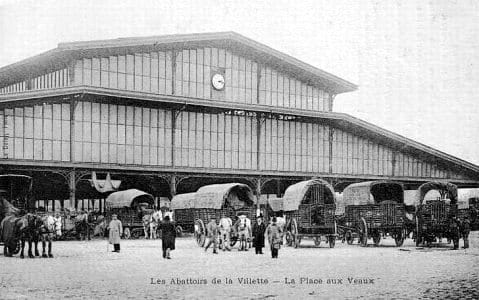
The Halle aux Moutons was a particularly striking expression of this new aesthetic, in which engineering and monumentality went hand in hand. Baltard’s approach was based on a light, clearly articulated framework, leaving the metal exposed rather than concealing it. Industrial technology became part of the architecture itself. The result was both highly functional and remarkably monumental: immense metal spans filled with light, evoking the scale and grandeur of a cathedral. The Halle aux Moutons was therefore part of the same architectural movement as Les Halles Centrales and, more broadly, of the transformation that reshaped Paris throughout the 19th century.
At La Villette, Baltard applied many of the principles behind Les Halles Centrales: modular construction, repeated structural elements, carefully planned circulation and an extensive use of iron to meet the demands of a vast industrial site. The construction of the market halls was subsequently entrusted to Jules de Mérindol, a pupil of Baltard, with the assistance of Louis-Adolphe Janvier.
Together, they created one of the most ambitious industrial complexes of modern Paris. Seen from the city’s fortifications and railway lines, the halls formed a vast landscape of iron and glass, ranking among the most striking sights of industrial Paris.
The Halle aux Moutons was a particularly striking expression of this new aesthetic, in which engineering and monumentality went hand in hand. Baltard’s approach was based on a light, clearly articulated framework, leaving the metal exposed rather than concealing it. Industrial technology became part of the architecture itself. The result was both highly functional and remarkably monumental: immense metal spans filled with light, evoking the scale and grandeur of a cathedral. The Halle aux Moutons was therefore part of the same architectural movement as Les Halles Centrales and, more broadly, of the transformation that reshaped Paris throughout the 19th century.
A vanished landmark returns
For more than a century, the Halle aux Moutons was an integral part of life at La Villette. When the slaughterhouses closed in 1974, the site was redeveloped and the hall was subsequently used as the Pavillon de Paris. It was eventually demolished in 1986.
Its fate echoed that of Victor Baltard’s Les Halles Centrales in the heart of Paris, dismantled between 1971 and 1973 despite strong opposition from heritage campaigners. Of Baltard’s celebrated complex, only a handful of pavilions survived, relocated outside Paris.
The Halle aux Moutons narrowly escaped complete destruction. Its framework was dismantled and preserved in the hope that it might one day be rebuilt. That reconstruction never came to pass. Instead, its 672 elements remained in storage for almost forty years, preserving a tangible fragment of a Paris that had disappeared.
Now, this remarkable survivor of industrial Paris is coming to auction, offering a rare opportunity to give new life to an emblematic work of Second Empire architecture. Forty years after the Halle aux Moutons disappeared from La Villette, its story may begin again - in a different setting, but still carrying the memory of Baltard’s Paris.
Its fate echoed that of Victor Baltard’s Les Halles Centrales in the heart of Paris, dismantled between 1971 and 1973 despite strong opposition from heritage campaigners. Of Baltard’s celebrated complex, only a handful of pavilions survived, relocated outside Paris.
Now, this remarkable survivor of industrial Paris is coming to auction, offering a rare opportunity to give new life to an emblematic work of Second Empire architecture. Forty years after the Halle aux Moutons disappeared from La Villette, its story may begin again - in a different setting, but still carrying the memory of Baltard’s Paris.


