FRIDAY, APRIL 10, 2026 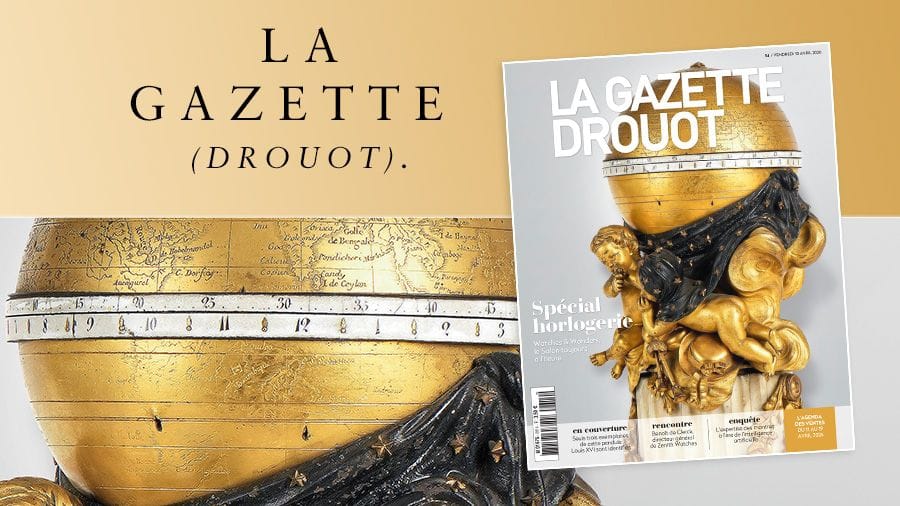
This Week in La Gazette Drouot : Two Putti and a Globe Adorn an Exceptional Clock
A t the heart of the prestigious collection assembled by Paul and Janine H. and soon to be dispersed, a rediscovered timepiece evokes the figure of a great aesthete of the late 18th century.
By Philippe Dufour
Read the full version of "Collection Paul and Janine H: Two Putti and a Globe Adorn an Exceptional Clock" in La Gazette Drouot
This gilt bronze and white marble clock, with its revolving circles - one for the hours, the other for the minutes - was in vogue in the last decades of the Ancien Régime, and bears all the hallmarks of the best of the Louis XVI style. Wrapped in a star-spangled drapery on a black background, a representation of the terrestrial globe rests on clouds where two winged putti frolic, one covering his head with the cloth, and the other pointing out the time on the enamelled dial, using an arrow that is now missing.
This dynamic ensemble is supported by a fluted column shaft with garlands of foliage and flowers, on a base with interlacing frieze and rosettes. This clock is an exceptional object, as only two other examples are known to date, and both use different materials. The first, entirely in gilded bronze, is in the collection of the Musée des Arts Décoratifs in Lyon, and the second, in turquoise-blue marble, was sold by Christie's New York on October 22, 2020, after a time in the Dalva Gallery in the same city...
As for the history of our extremely rare clock, it may well have begun with the flamboyant Baron Pierre Nicolas Van Hoorn Van Vlooswyck (1743-1809), a Dutchman who settled in Paris at the end of the 18th century, amassing an impressive collection of paintings, furniture and objets d'art acquired from the capital's finest dealers.

Discover a world of art and auctions with La Gazette Drouot
Every week, since 1891, La Gazette Drouot has been the authoritative weekly for public auctions of furniture, paintings and objets d'art. Our issues published contain thousands of articles which explain, decipher and analyse objects as well as their market, while others give leading figures a forum for sharing their passion. And not forgetting the cultural news, enlightened by in-depth articles on diverse subjects, often published for the first time.
You too can enjoy this wealth of information and images by picking up La Gazette Drouot.
You too can enjoy this wealth of information and images by picking up La Gazette Drouot.