
DIENSTAG, 16. JUNI 2026 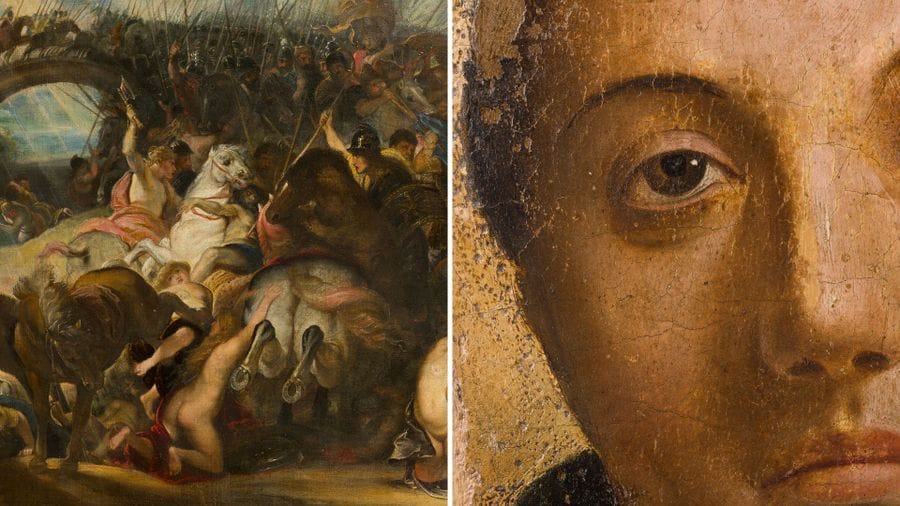
Antonello da Messina is a towering figure in Western art. Like Leonardo da Vinci or Vermeer, he is known for a very limited number of striking and celebrated works. Only around forty of his paintings have survived, including some fifteen iconic portraits and twenty-five religious subjects. The discovery of this painting therefore represents a significant addition to the artist’s corpus.
Antonello da Messina is credited with introducing oil painting techniques to Italy, and with forging a link between the realist tradition of Van Eyck and Petrus Christus in Flanders and the early Italian Renaissance.
His intellectual acuity enabled him to assimilate a wide range of influences: Northern technical mastery, Florentine spatial construction, the soft light of Piero della Francesca, and his dialogue with Giovanni Bellini during his stay in Venice. All of this makes his work the quintessence of Quattrocento art, just before Leonardo da Vinci pushed these innovations even further.
These characteristics are evident in this previously unpublished panel: a face constructed as an ovoid geometric volume, the frontal pose of the figure, sometimes enhanced by a very slight turn that emphasises the features, the gold background, and the punchwork of the halo comparable to that found in several of his works preserved in Sicily, notably the Christ Child from the Polyptych of Saint Gregory (Regional Museum of Messina, circa 1472–1475).
The work also shares many elements with his universally renowned masterpieces painted during his Venetian period: Il Condottiere (Musée du Louvre) and, above all, the San Cassiano Altarpiece (Vienna, Kunsthistorisches Museum), where the faces appear almost superimposed.
In the absence of a specific attribute, it is difficult to identify the figure, who was most likely a religious or a saint. It is possible that this painting formed the central panel of a processional banner (gonfalon) – it is known that upon his return to Sicily, Antonello produced several such works for churches in Catania
Rubens & Antonello Da Messina : Two Masterpieces
A der is unveiling two major paintings from the Italian Renaissance and the Baroque period. Discovered in a private collection, they are by Antonello da Messina and Peter Paul Rubens. These two previously unseen works will be presented at public auction for the very first time on 16 June at Hôtel Drouot.
The first painting, a portrait of a Saint on panel by Antonello da Messina, executed circa 1476–1477 upon his return to Sicily, is a remarkable discovery by the great technician of the Italian Renaissance (estimate: €1–2 million). The second, The Battle of the Amazons, is an early work painted circa 1603–1606 by the master of Baroque painting, Peter Paul Rubens (estimate: €2–3 million). This powerful composition had been untraced since the 17th century before being rediscovered by David Jaffé, former curator at the National Gallery, London, in 2005.
Antonello da Messina – A rare work joins a corpus of only 40 paintings

Antonello da Messina is a towering figure in Western art. Like Leonardo da Vinci or Vermeer, he is known for a very limited number of striking and celebrated works. Only around forty of his paintings have survived, including some fifteen iconic portraits and twenty-five religious subjects. The discovery of this painting therefore represents a significant addition to the artist’s corpus.
Antonello da Messina is credited with introducing oil painting techniques to Italy, and with forging a link between the realist tradition of Van Eyck and Petrus Christus in Flanders and the early Italian Renaissance.
His intellectual acuity enabled him to assimilate a wide range of influences: Northern technical mastery, Florentine spatial construction, the soft light of Piero della Francesca, and his dialogue with Giovanni Bellini during his stay in Venice. All of this makes his work the quintessence of Quattrocento art, just before Leonardo da Vinci pushed these innovations even further.
These characteristics are evident in this previously unpublished panel: a face constructed as an ovoid geometric volume, the frontal pose of the figure, sometimes enhanced by a very slight turn that emphasises the features, the gold background, and the punchwork of the halo comparable to that found in several of his works preserved in Sicily, notably the Christ Child from the Polyptych of Saint Gregory (Regional Museum of Messina, circa 1472–1475).
The work also shares many elements with his universally renowned masterpieces painted during his Venetian period: Il Condottiere (Musée du Louvre) and, above all, the San Cassiano Altarpiece (Vienna, Kunsthistorisches Museum), where the faces appear almost superimposed.
In the absence of a specific attribute, it is difficult to identify the figure, who was most likely a religious or a saint. It is possible that this painting formed the central panel of a processional banner (gonfalon) – it is known that upon his return to Sicily, Antonello produced several such works for churches in Catania
A powerful early work by Rubens

From an early age, Rubens painted ambitious compositions inspired by Greco-Roman antiquity, combining dozens of nude and clothed figures in motion – a striking display of precocious ambition and virtuosity. The subject of the Battle of the Amazons particularly fascinated him, and he returned to it several times. He first treated it in Antwerp, in collaboration with Jan I Brueghel (Potsdam, Sanssouci Palace) around 1597–1598; the version presented by Ader dates from his stay in Mantua circa 1603–1606; and he revisited it again in a celebrated, swirling composition of 1618 (Munich, Alte Pinakothek).
Between the two early works, the composition was entirely rethought. Rubens adopts a more Italianate landscape, paying particular attention to the interplay of rising dust and sunlight shimmering through the clouds. The arched bridge, moved from right to left and given prominence, anticipates a veritable ballet of lances slicing through the background. Like a giant wave, the Greek cavalry crashes onto the shore, overwhelming everything in its path.
Under the guise of a mythological subject, Rubens depicts a battle scene at its most intense – a favoured theme of the Renaissance. Despite the horror of severed heads and impaled bodies, the palette lends the scene an almost dreamlike quality. One can almost hear the cries issuing from open mouths and the clash of trumpets, as horses and riders are cut down by a descending phalanx of spears.
This painting is a complex assemblage of motifs borrowed from classical antiquity and the Renaissance, particularly sculpture: the group of Hercules struggling with two women recalls the Laocoön; the rearing horse at the far left echoes that of the Dioscuri of Monte Cavallo in Rome; the horses draw on the central motif of Leonardo da Vinci’s Battle of Anghiari; while the overall composition and other details refer to Raphael’s Battle of Constantine against Maxentius (The Battle of the Milvian Bridge) in the Vatican, as well as Titian’s lost Battle of Spoleto.
Appointed court painter in 1603 by the major patron and collector Vincenzo Gonzaga, Rubens then produced his first great masterpieces, fully integrating his Greco-Roman culture and surpassing the compositions of the Renaissance and Mannerism.
Here, the artist expresses a fluidity of movement and a swirling interplay of groups that fully belongs to the Baroque, of which this painting is one of the earliest expressions. Rubens is already developing the personal style he would refine throughout his career, influencing European painting for centuries.
evenement vom 28 Oktober bis 9 November 2026
"Nouveau Regard" : A Selection of Works By Judith Touitou
evenement vom 31 Oktober bis 11 Dezember 2026
Un Samedi à Drouot | Découvrez l’univers fascinant des enchères
annonce 29 Oktober 2026


