
MERCREDI 11 JUIN 2025 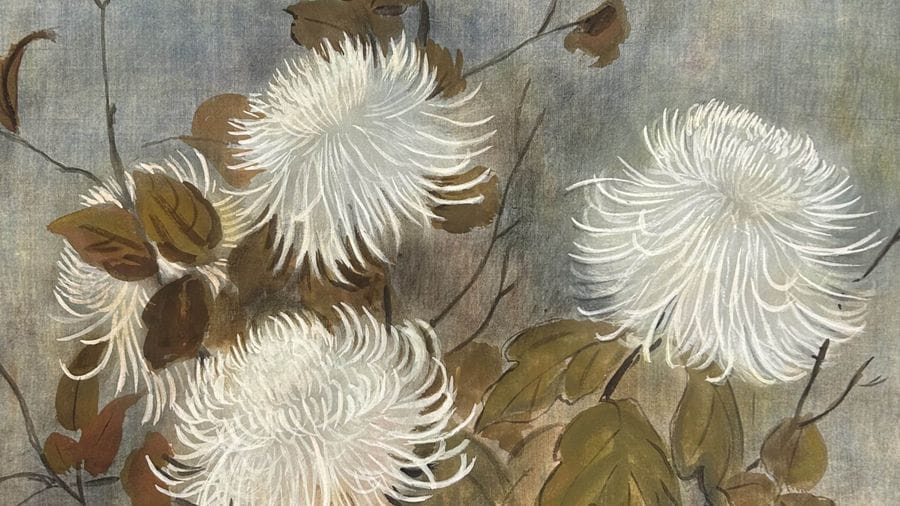
A look at twentieth-century Vietnamese art from the collection of Mr Nguyễn Dê
O n 11 June, the auction house Varenne Enchères will present at the Hôtel Drouot the collection of Mr Nguyễn Dê, former chief of staff to Emperor Bảo Đại, offering a rare insight into modern Vietnamese art.
Among the highlights from this prestigious estate are two ink on silk works by Lê Phổ and Mai Trung Thứ. Both artists shared not only a common training—having studied in the first cohort of the École des Beaux-Arts de l’Indochine in Hanoi—but also a similar path: each spent most of his career in France.
After an initial journey in 1931 and a brief return to Vietnam the following year, Lê Phổ ultimately came back to France in 1937 to oversee the Indochinese section of the Exposition Universelle, soon joined by Mai Thứ.
Following the Second World War, both settled permanently in France—Lê Phổ in Nice and Mai Thứ in Mâcon—where they were supported by patron families, for whom they painted numerous portraits. It was during this period that they gradually abandoned oil painting in favour of silk painting mounted on cardboard, a technique developed in 1925 at the Hanoi school. Blending East Asian and Western influences, this medium appealed to French collectors drawn to its refined aesthetic and its subtle dialogue between tradition and modernity.

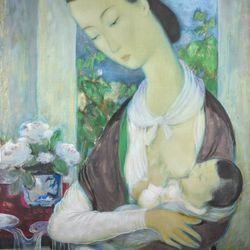
Painted in the early 1950s, Maternity—estimated at €200,000–300,000—reflects the artist’s lasting fascination with Italian Primitives. In late 1931, Lê Phổ travelled to Italy, Belgium and the Netherlands, a formative experience that left a deep imprint on his work, particularly in relation to sacred European art. The semicircular arch is a direct reference to Italian painting, while the tight framing recalls Flemish portraiture. The motif of the mother and child, a recurrent theme in his oeuvre, may also be read as an homage to the Italian Madonna. Here, Lê Phổ’s brushwork is light, almost ethereal. His aim is not so much to depict the woman with precision, but rather to evoke a sense of tenderness, harmony and serenity.
In a similar spirit of synthesis between East and West, Yellow Vase with Chrysanthemums, dated 1953, exemplifies the approach of Mai Trung Thứ. The work references the Western genre of still life—with a bouquet of flowers in a vase set upon a table—while also echoing the "bird and flower" tradition of East Asian painting. The artist’s virtuosity is evident in the finely rendered foliage and chrysanthemum blossoms.
In a similar spirit of synthesis between East and West, Yellow Vase with Chrysanthemums, dated 1953, exemplifies the approach of Mai Trung Thứ. The work references the Western genre of still life—with a bouquet of flowers in a vase set upon a table—while also echoing the "bird and flower" tradition of East Asian painting. The artist’s virtuosity is evident in the finely rendered foliage and chrysanthemum blossoms.
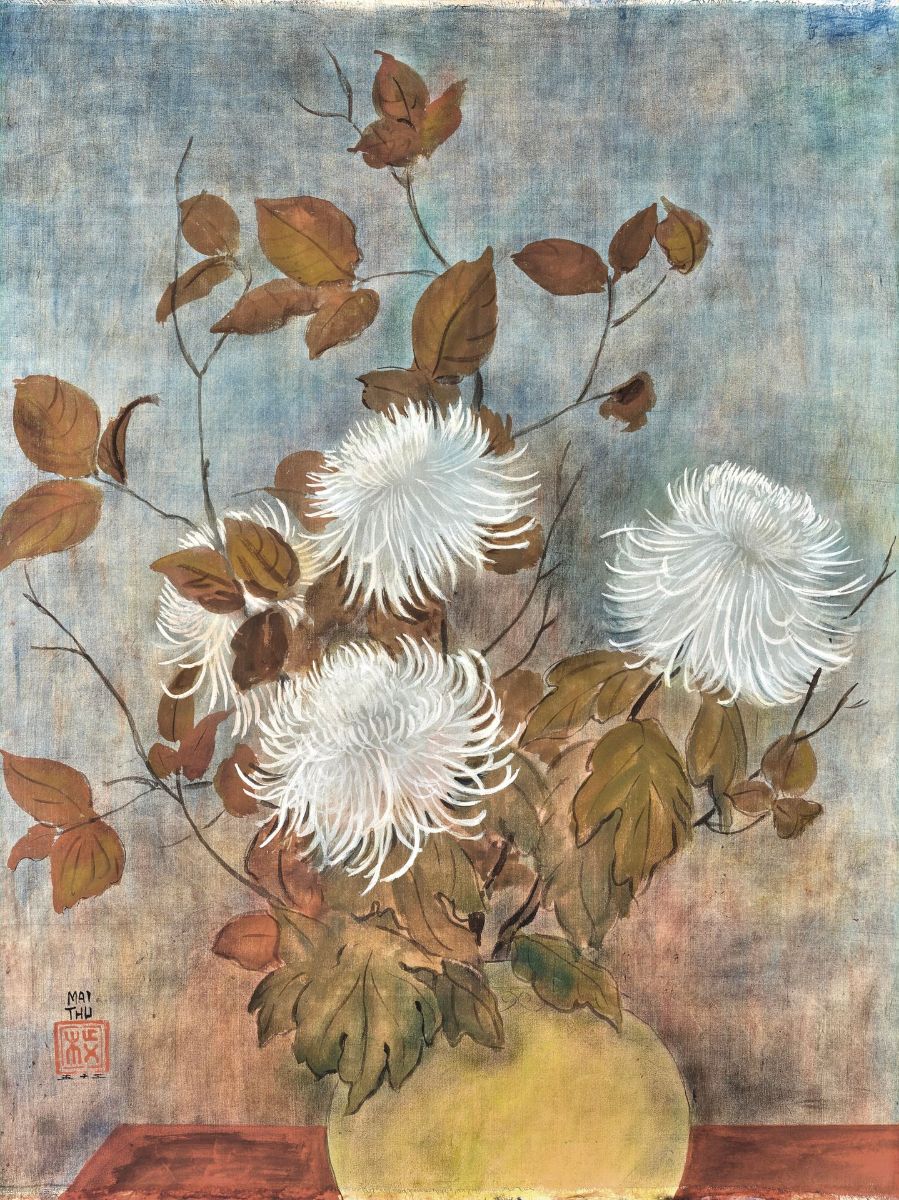
Though often described as traditional, Mai Thứ’s work is in fact the product of a highly deliberate synthesis: strict linework, a restrained thematic repertoire, meticulously composed scenes, and a wealth of artistic references. The piece is further enhanced by a wooden frame adorned with gold and silver floral motifs—crafted by the artist himself. Once again, the frame embodies a fusion of forms, blending Western gilded wood with Eastern lotus scrolls.
While Lê Phổ returned to oil painting after the 1950s, Mai Trung Thứ continued to work in ink on silk throughout his career, remaining faithful to this delicate and poetic medium.
While Lê Phổ returned to oil painting after the 1950s, Mai Trung Thứ continued to work in ink on silk throughout his career, remaining faithful to this delicate and poetic medium.
live 11 juin | 14:00
COLLECTION DE NGUYEN DÊ, DIRECTEUR DE CABINET DE L'EMPEREUR BAO DAI ET A DIVERS : Dessins - Tableaux anciens, modernes & contemporains - Ecole des Beaux Arts d'Hanoï - Arts d'Asie - Sculptures - Arts modernes & contemporains - Mobilier XXème
Varenne Enchères
Hôtel Drouot - Salle 16, Paris


