FRIDAY, DECEMBER 19, 2025 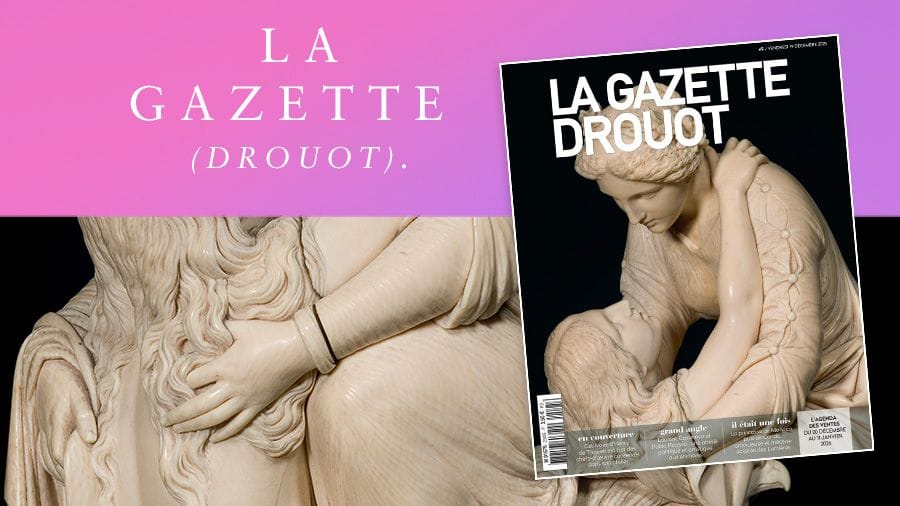
This Week in La Gazette Drouot : The ambition of ivory by Henry de Triqueti, Queen Victoria's sculptor
T he sculptor's most surprising piece, deliberately kept in his studio, reveals both his innermost spiritual aspirations and the breadth of his artistic vision.
By Carole Blumenfeld
Read the full version of The ambition of ivory by Henry de Triqueti, Queen Victoria's sculptor in La Gazette Drouot
The works of Henry - also known as Henri - de Triqueti (1803-1874), once dispersed or considered impossible to find, are now attracting a great deal of attention from major institutions. It's as if they wanted to make up for the oblivion in which these pieces had lain! And to do so, they are reintegrating them into their collections. The Vase from the Monument to Dante and Petrarch, acquired last year by the Musée du Louvre from the Galerie de Bayser, has reappeared after decades of eclipse, not to mention the no less striking rediscovery of La Mort de Cléopâtre, an admirable ivory now in the Victoria and Albert Museum - and recently obtained from Tulissio Antiques.
Félicie de Fauveau's rival was never completely forgotten: neither in Paris, where the artist of the doors to the Madeleine church and the Prince of Orléans' cenotaph (Notre-Dame-de-Compassion) remained easily recognizable, nor in Windsor, where his decoration of Prince Albert's chapel stands out. But alongside these very famous works, since the 2007-2008 retrospective in Montargis and Orléans, and even more recently with "Triqueti, la force du trait" at the Musée Girodet (2022-2023), his more intimate work has been widely revived.
The Roman-inspired group thus took shape very early on. However, the dynamics of this silent choreography between the nude Mary Magdalene and the ancient allegory of Mercy were not yet in evidence. In 1840, Triqueti executed in marble an imposing penitent Magdalene, an authentic squatting Aphrodite of Canovian inspiration, whose modesty is preserved by the fullness of her hair: the work was intended for Charles Amable d'Espagnac, whose great-uncle, Frédéric-Guillaume, had owned the Estense residence in Modena since 1796, where it is preserved today.
Read the full version of The ambition of ivory by Henry de Triqueti, Queen Victoria's sculptor in La Gazette Drouot
The works of Henry - also known as Henri - de Triqueti (1803-1874), once dispersed or considered impossible to find, are now attracting a great deal of attention from major institutions. It's as if they wanted to make up for the oblivion in which these pieces had lain! And to do so, they are reintegrating them into their collections. The Vase from the Monument to Dante and Petrarch, acquired last year by the Musée du Louvre from the Galerie de Bayser, has reappeared after decades of eclipse, not to mention the no less striking rediscovery of La Mort de Cléopâtre, an admirable ivory now in the Victoria and Albert Museum - and recently obtained from Tulissio Antiques.
Félicie de Fauveau's rival was never completely forgotten: neither in Paris, where the artist of the doors to the Madeleine church and the Prince of Orléans' cenotaph (Notre-Dame-de-Compassion) remained easily recognizable, nor in Windsor, where his decoration of Prince Albert's chapel stands out. But alongside these very famous works, since the 2007-2008 retrospective in Montargis and Orléans, and even more recently with "Triqueti, la force du trait" at the Musée Girodet (2022-2023), his more intimate work has been widely revived.
An intimate path to ivory, the material of the flesh
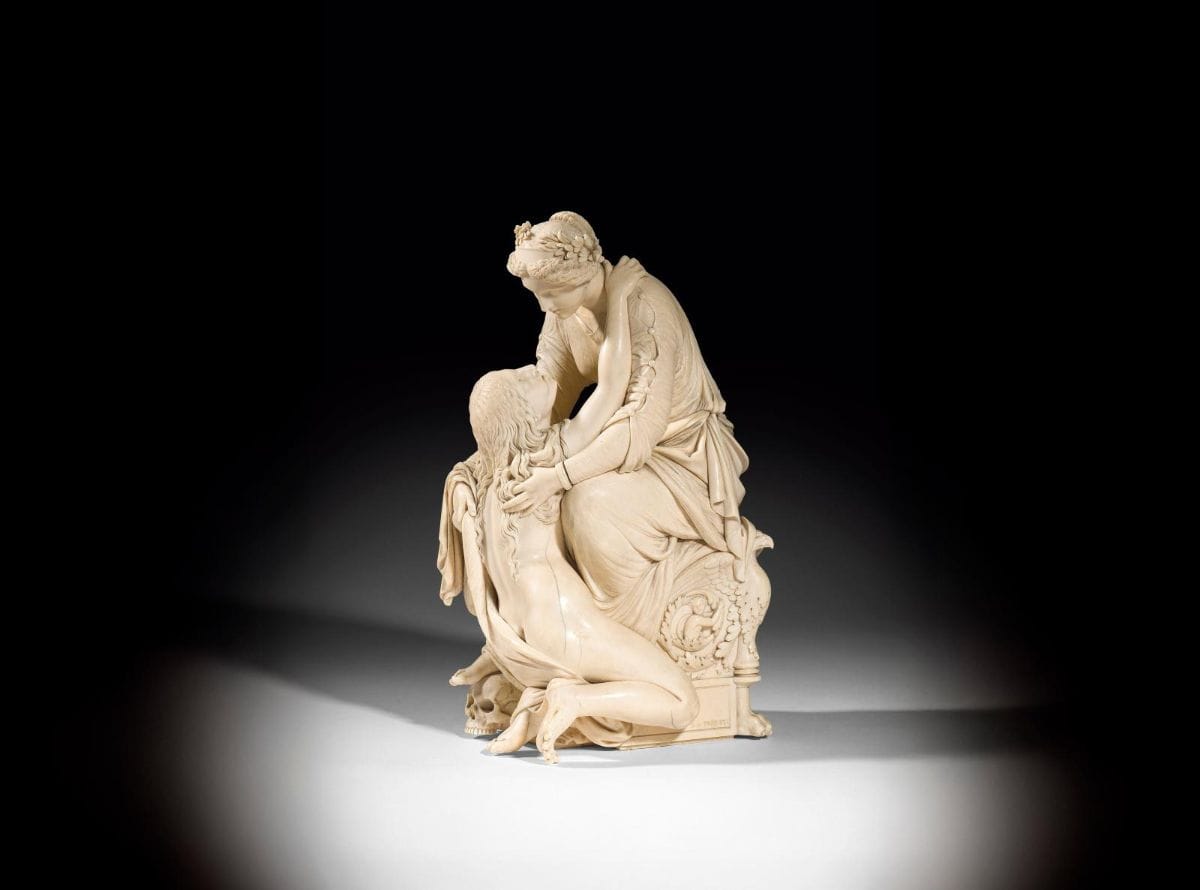
Among the family collection to be auctioned at Drouot on February 12, this ivory, La Miséricorde divine accueillant le Repentir (Divine Mercy Welcoming Repentance ), occupies a singular place in this rediscovery movement. A tour de force of inventiveness and dexterity, the piece is one of the pinnacles of 19th-century French sculpture. From the pen-and-ink drawing executed in Pisa on November 26, 1836 - and simply entitled Misericordia (Paris, Beaux-Arts) - to the plaster in the Musée Girodet, for which Élodie Jeannest de Gyvès maintains a date close to 1864, the artist fashioned a veritable pantheon of female figures, nourished by his readings and aesthetic affinities.The Roman-inspired group thus took shape very early on. However, the dynamics of this silent choreography between the nude Mary Magdalene and the ancient allegory of Mercy were not yet in evidence. In 1840, Triqueti executed in marble an imposing penitent Magdalene, an authentic squatting Aphrodite of Canovian inspiration, whose modesty is preserved by the fullness of her hair: the work was intended for Charles Amable d'Espagnac, whose great-uncle, Frédéric-Guillaume, had owned the Estense residence in Modena since 1796, where it is preserved today.

Discover a world of art and auctions with La Gazette Drouot
Every week, since 1891, La Gazette Drouot has been the authoritative weekly for public auctions of furniture, paintings and objets d'art. Our issues published contain thousands of articles which explain, decipher and analyse objects as well as their market, while others give leading figures a forum for sharing their passion. And not forgetting the cultural news, enlightened by in-depth articles on diverse subjects, often published for the first time.
You too can enjoy this wealth of information and images by picking up La Gazette Drouot.
You too can enjoy this wealth of information and images by picking up La Gazette Drouot.