
En décembre à Drouot
Villanfray Pommery | Vente Cataloguée - Successions & à Divers
3 December
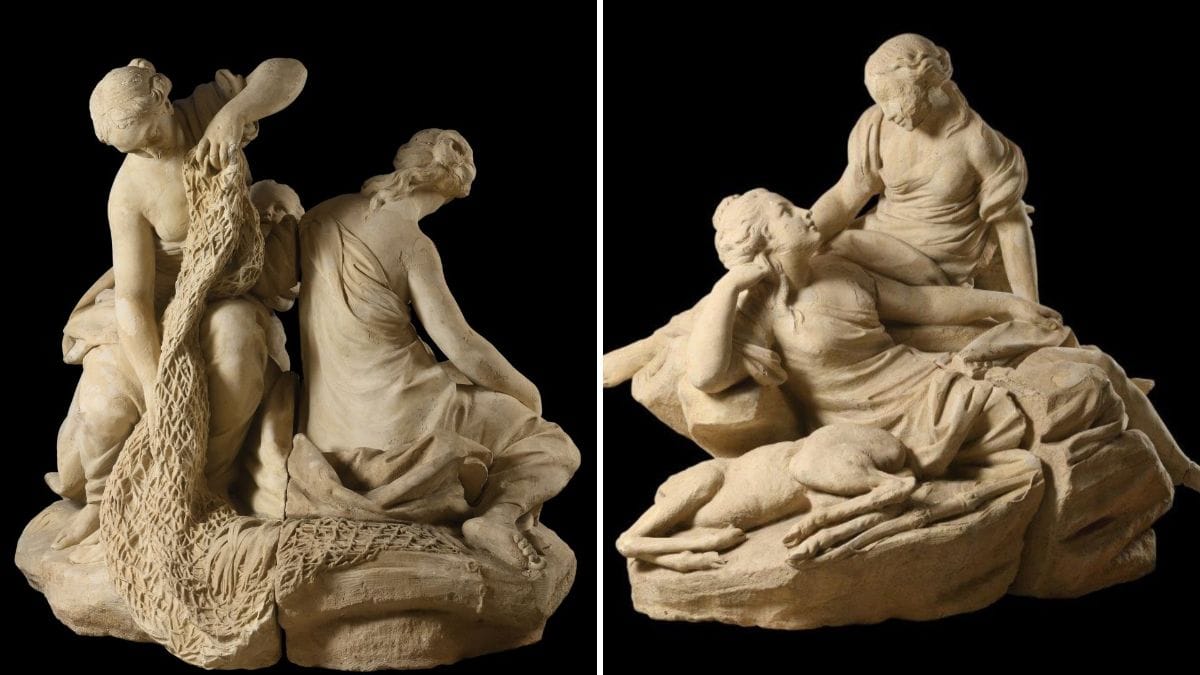
Completed in 1780, shortly after Étienne-Maurice Falconet’s return from Russia, La Chasse and La Pêche reappear today as two monumental sculptures of rare significance. Although derived from models made for Sèvres in 1758, they had never been catalogued in the artist’s catalogue raisonné. Their attribution was confirmed by an unpublished text by historian Louis Réau, preserved at the Louvre.
Elegant and dynamic compositions
The stone groups depict the allegories of hunting and fishing through graceful nymphs and playful putti. Falconet deploys his characteristic vocabulary: elongated silhouettes draped in classical style, a rotating composition offering multiple viewpoints. The Rococo spirit remains, yet is tempered by the early stirrings of Neoclassicism.
Origins: Sèvres, 1758
The sculptures are large-scale adaptations of two models originally conceived for the Royal Manufacture of Sèvres. Designed for table centrepieces, these compositions were among the works that established Falconet’s reputation, supported by Madame de Pompadour and influenced by the graceful world of François Boucher.
A monumental project completed after Russia
Returning to France after twelve years in the service of Catherine II — a period during which he created the famous Bronze Horseman — Falconet resumed several suspended projects. The inscription “1780” on La Pêche confirms these works belong to this pivotal moment in his career.
A new aesthetic for garden sculpture
Designed for a park setting, La Chasse and La Pêche break with the Baroque tradition still dominant among sculptors of the time. Falconet favours serene, horizontal scenes intended to interact subtly with the landscape. Their innovative, intimate, and refined composition prefigures a new approach to outdoor sculpture.
Provenance and rediscovery
These sculptures, marking Falconet’s shift from Rococo to a more restrained Neoclassicism, were absent from Louis Réau’s 1922 catalogue. The historian later identified them on the Côte d’Azur and dedicated a typescript to them, now kept at the Louvre. Their journey has been partially reconstructed: visible around 1922 at the Villa Fantasia in Èze, then in the collection of Antenor Patiño, they subsequently adorned the Château de Rubelles and the Sandricourt estate.
Giquello | Antique et Classique
5 December
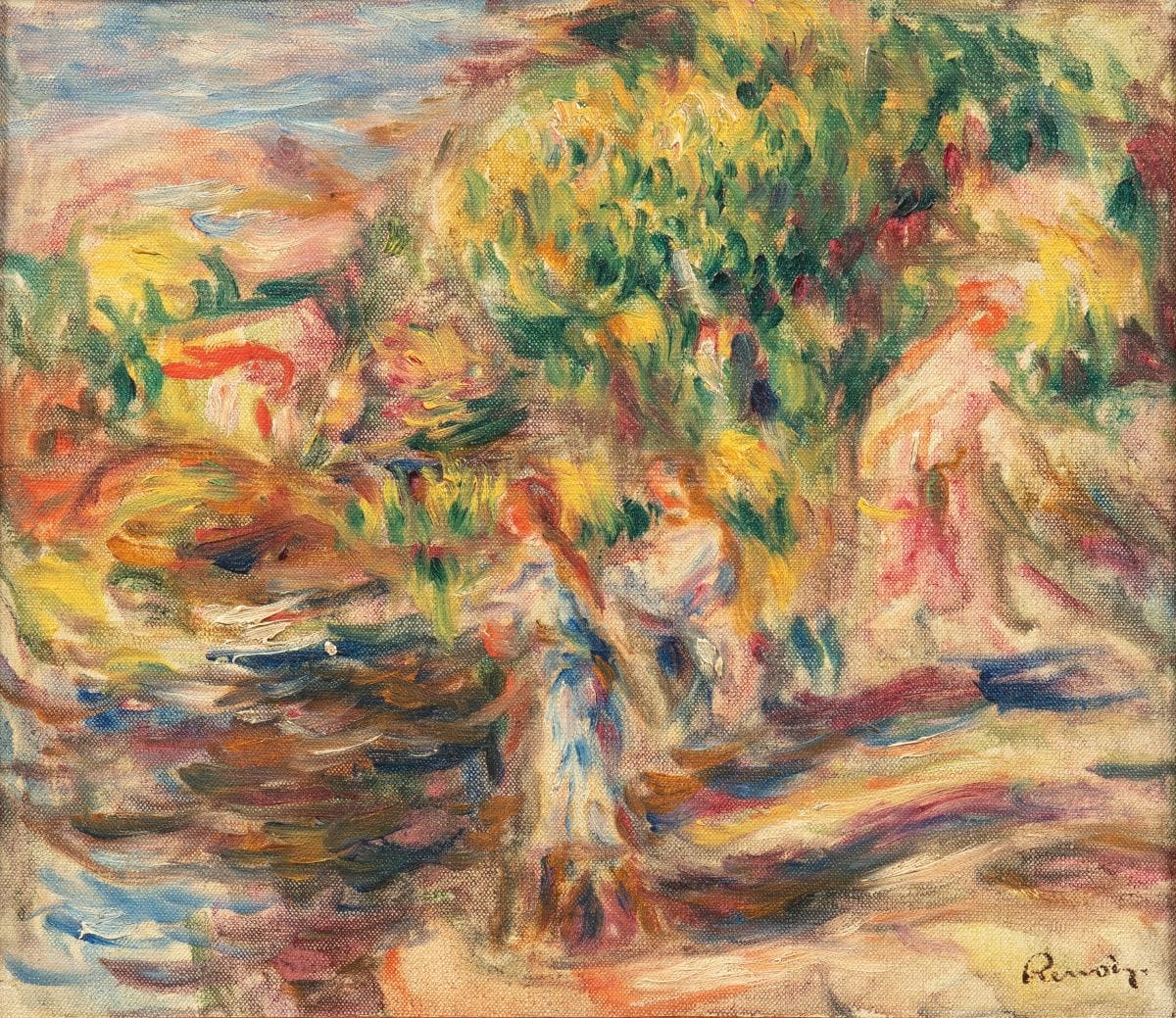
On 5 December at Hôtel Drouot, Giquello will offer a major painting by Pierre-Auguste Renoir from the former Alfred Weinberger collection, whose works had been seized during the Second World War. This sale follows the restitution of the work to the heirs.
Seized works and an exiled collector
Alfred Weinberger, a respected expert and art dealer born on 7 April 1887 in Losoncz, Hungary, had been residing in Paris for many years when he fled to Aix-les-Bains at the start of the Occupation. Before leaving, he deposited several paintings, including five Renoirs, at Morgan & Cie bank in Paris for safekeeping. Despite these precautions, the Nazi authorities seized them shortly thereafter.
The seized paintings were inventoried by the Einsatzstab Reichsleiter Rosenberg (ERR), then placed at the Jeu de Paume on 4 December 1941 before being transferred to Germany. Bruno Lohse, the Nazi expert in charge, confirmed both the inventory and the transfer to Germany in 1942, on Göring’s orders.
Renoir’s Laveuse had belonged to Alfred Weinberger since 1925, as confirmed by a letter from the Renou & Poyet gallery (12 May 1958), and came from the artist’s estate. Paysage avec pommiers et femme (31×31 cm) appears in the ERR photographic archives, preserved at the Bundesarchiv in Koblenz (Wbg 124), and was listed post-war in the French spoliated property register (No. 6396) under Weinberger’s name.
A discovery illuminating the painting’s history
The work, publicly auctioned for the first time in May 2023, was discovered in an estate inventory conducted by Giquello. Acquired in good faith by a collector in the 1980s from the Segoura gallery, the work came with standard certifications: Wildenstein certificate and free circulation licence from the French Museums Directorate.
It was, however, the 2023 purchaser who uncovered the trace of its spoliation while consulting the archives. Giquello immediately cancelled the sale and engaged a German legal firm, leading to the restitution of the work to the Weinberger heirs, who then entrusted it to the auction house for resale at Drouot on 5 December.e.
Tessier & Sarrou | 20th Century
5 December
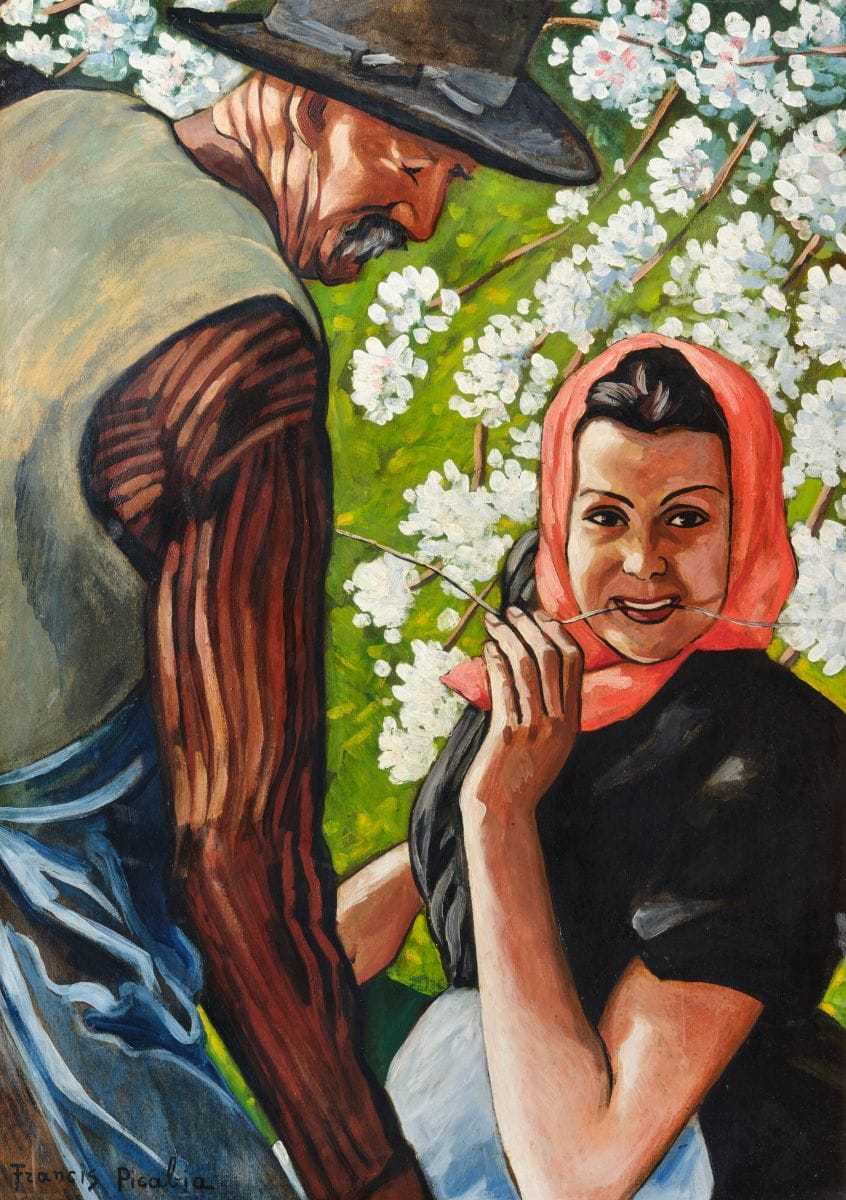
On 5 December at Hôtel Drouot, Tessier – Sarrou will present a major work by Francis Picabia, held in the same collection since 1942. The collector acquired it at a sale organised by the Red Cross for the benefit of American soldiers in Algiers in 1942.
Picabia in Golfe-Juan: a stylistic turning point
In 1940, fleeing Paris and the Occupation, Picabia settled in Golfe-Juan on the French Riviera. Once a leading figure of the Dada movement, the artist entered a singular and puzzling phase of his career. Amid war and isolation, he moved away from the abstract experiments and conceptual provocations that had made his fame, turning instead to figurative painting of often ambiguous realism. He devoted himself to large canvases depicting pastoral and peasant scenes, nudes, or sentimental figures.
The “sentimental period,” between pastiche and ambiguity
He painted idealised women and couples as refuges in a chaotic world, maintaining a critical distance. Inspired by popular magazine photographs (Mon Paris, Paris Magazine, etc.), charms, and calendars, these works are far more than a simple return to tradition: they reflect an ironic appropriation of popular imagery. The models, often copied openly, are recomposed with a smooth, artificial touch, giving these paintings an atmosphere at once seductive and unsettling. This “period of realistic transparencies,” or “sentimental period,” as critics call it, represents a break from his earlier avant-garde Dada language. Yet beneath this apparent concession to public taste, Picabia continued his subversive work, blurring the lines between high art and mass culture, sincerity and pastiche, beauty and kitsch.
A pivotal work in the history of modernism
Long misunderstood, these works were rediscovered from the 1970s and are now recognised as a crucial stage in Picabia’s oeuvre, anticipating appropriationist art, a rebellious heir to both Dada and Pop Art, and the postmodern. In the deceptive calm of the Midi at Golfe-Juan, Picabia continued to question, in new forms, the very meaning of painting and imagery.
DIGARD AUCTION | Line Vautrin Exclusive
9 December
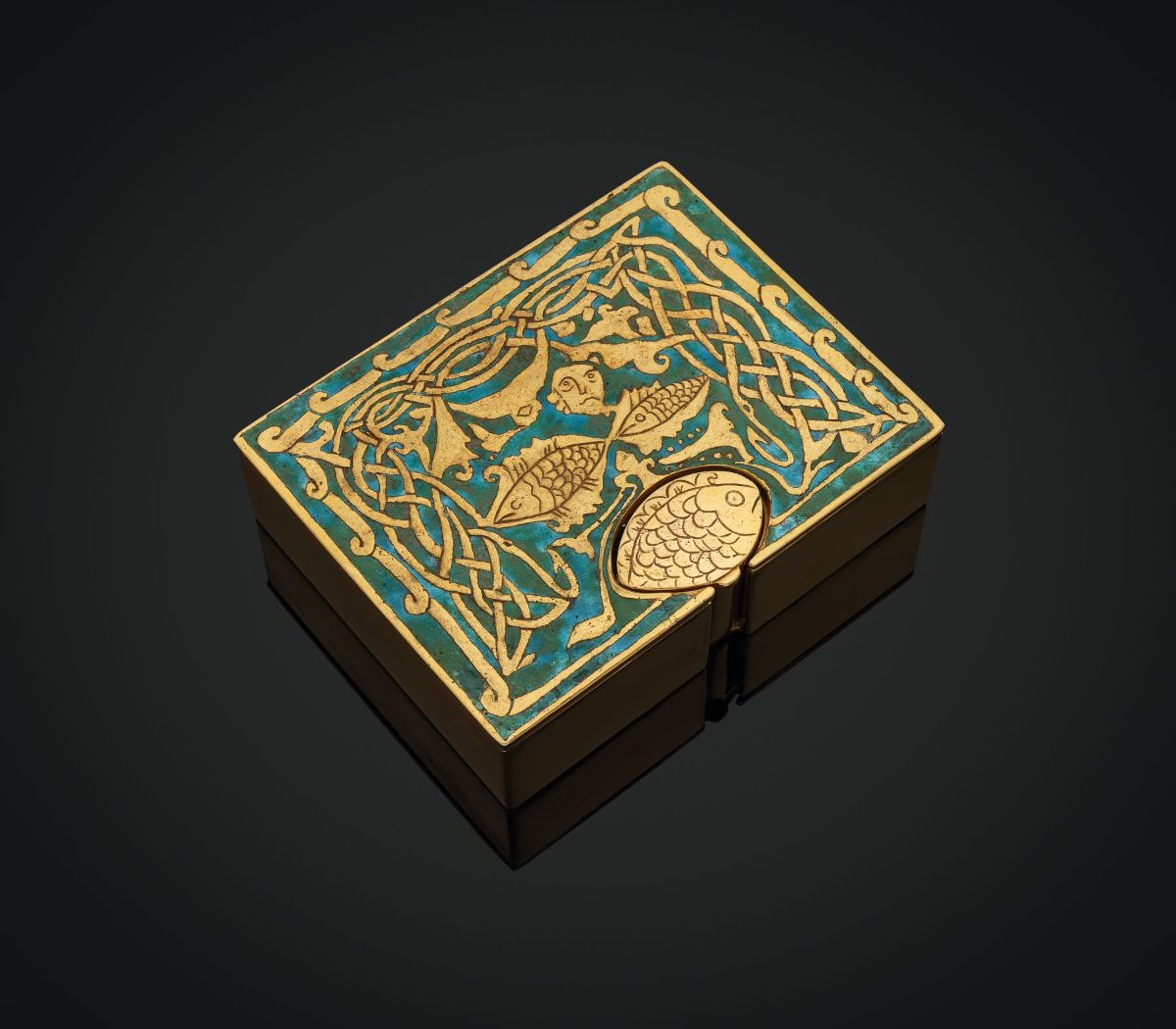
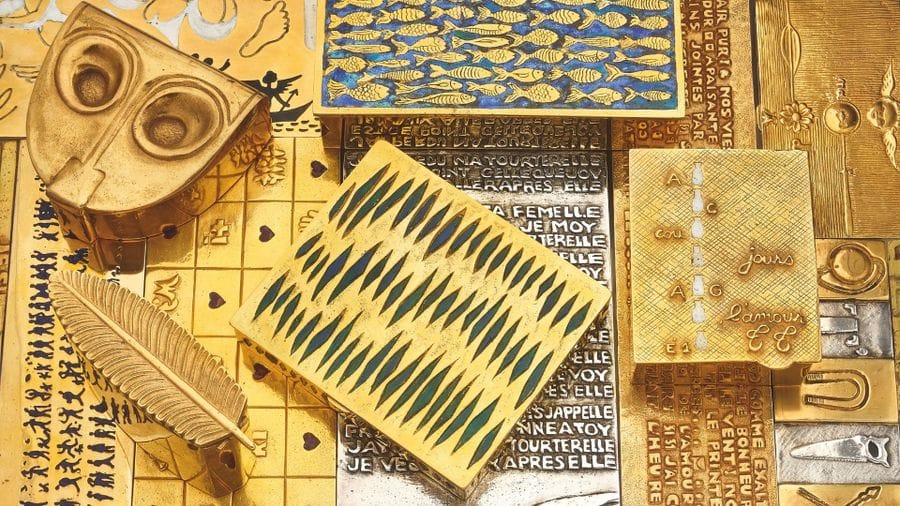
Started over thirty years ago, this unique collection of 83 gilded bronze boxes by Line Vautrin (1913–1997) is today one of the most important ever offered at auction. Gathering emblematic, sometimes rare pieces estimated between €2,000 and €15,000, it offers a fresh perspective on the work of the French designer, celebrated for her “witch mirrors” and a universe where playfulness, poetry, and mystery intertwine.
Poetry, puzzles, and secrets
Each box holds a secret beneath its cork-sealed lid. Inspired by rebuses, wordplay, cut-out silhouettes, and inlaid images, the collection reflects Vautrin’s poetic and playful imagination: “A childlike, mischievous, and spontaneous world,” according to Karine Rapinat, president of the Line Vautrin Foundation. The catalogue highlights several emblematic pieces, including La pêche aux poissons (lot 46), Je t’aime aujourd’hui plus qu’hier et moins que demain (lot 38, est. €8,000–12,000), and Tapisserie (lot 28, est. €5,000–7,000), each illustrating her narrative inventiveness and finesse.
Art between tradition and modernity
Line Vautrin drew on French culture from the Middle Ages to the Renaissance, Western and Eastern mythologies, and paid homage to literature and poetry. Her creations evoke Pierre Ronsard, Guillaume Apollinaire, or Christian cosmogonies (Prayer of Saint Francis of Assisi), combining humour, irony, and elegance.
A singular and visionary designer
Independent, feminist, and innovative, Vautrin produced a unique corpus, blending minimalism and ornamentation, poetry and humour, high art and popular culture. She directed her workshop with up to 50 artisans, creating plaster models before casting them in bronze. Long considered marginal, her work is now recognised as a key stage in French decorative arts, anticipating dialogues between art, jewellery, and ornamentation.
Pescheteau-Badin | Objets d’Art & d’Ameublement
11–12 December

The only known Boucher still life at auction
This previously unseen work, never before on the art market or at auction, reveals a completely unknown facet of the royal painter: his daily practice of still life.
A unique work within the painter’s corpus
This still life constitutes an important addition to François Boucher’s painted oeuvre. It is a unique subject in the master’s body of work, showing the influence of 17th-century Northern masters who had inspired Boucher a decade earlier.
Oudry’s influence and hunting art
These hunting-related still-life subjects immediately recall Jean-Baptiste Oudry, court painter to the King, who maintained a close relationship with the young Boucher, twenty years his junior. This painting demonstrates the artist’s mastery of a rarely represented genre in his oeuvre and suggests that such hunting trophies may have been commissioned by a patron. The discreet signature, applied directly onto the paint surface, further indicates a commissioned work rather than a mere exercise, despite the simplicity of the subject.
Boucher: beyond Rocaille
Painter to the King and director of the Royal Academy, François Boucher epitomised 18th-century French art. A pupil of François Lemoyne, Prix de Rome 1723, he developed a graceful, sensual style that captivated the aristocracy.
As Madame de Pompadour’s principal painter, he excelled in galant scenes, mythology, and pastorals defining the Rocaille aesthetic. His influence extended far beyond painting: tapestry cartoons, opera sets, decorative arts. Master to Fragonard and many of his generation, Boucher dominated Parisian art for nearly forty years. This still life reveals a previously unknown facet of his genius: far from idyllic shepherdesses and powdered Venuses, it demonstrates his technical rigour and daily discipline in a genre he practised diligently but never exhibited.
Orne Enchères | Icône(s)
15 December
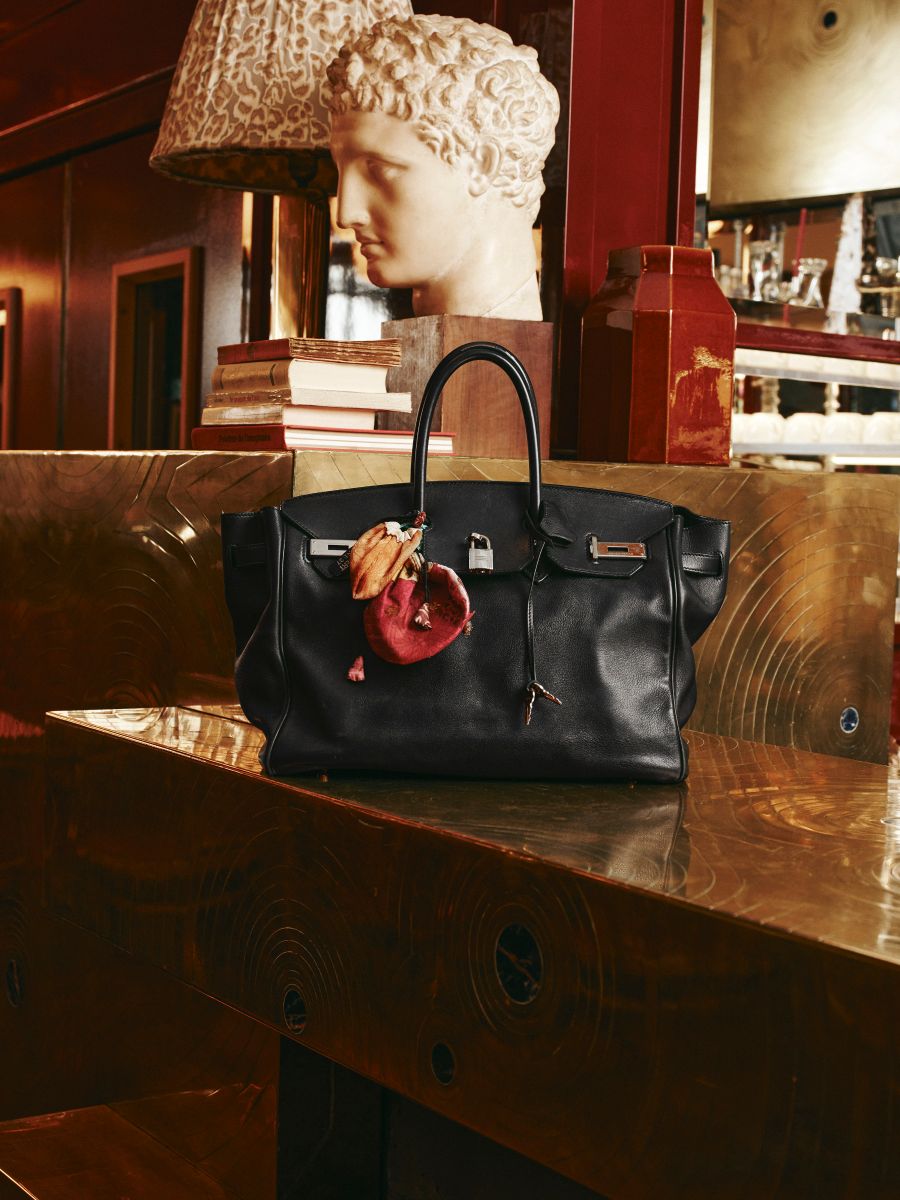
At Hôtel Drouot, Orne Enchères will offer one of the first bags Hermès gave to Jane Birkin, sold by Gabrielle Crawford, the actress’s closest friend and biographer, to help fund the future Jane Birkin Foundation. The original English typescript of the cult film Je t’aime moi non plus, annotated by Serge Gainsbourg and Jane Birkin, will also be offered, with proceeds going to the foundation (estimate: €15,000–18,000).
A unique bag entrusted to her “angel Gabrielle”
While Jane Birkin had donated several bags for charity auctions, she had kept this one — probably her favourite — in the care of her best friend, Gabrielle, whom she called her “angel Gabrielle.” The bag bore the traces of her commitments through the charms hanging from its handles. Gabrielle recalls that Jane’s bag “became a sort of mobile storage. Gifts from around the world were attached to the handles — bells, Japanese talismans… It weighed a ton. But she and the bag were inseparable. She never forgot it.”
The story behind the iconic Birkin bag
The story of the Birkin’s creation is now well-known: on a flight, seated unknowingly next to Jean-Louis Dumas, Hermès president, Jane Birkin emptied her basket handbag, complaining there was no model that large at Hermès. This chance encounter led to the first Birkin in 1984.
Over 40 years later, this Hermès icon remains the most sought-after by collectors and fashion lovers worldwide. Jane Birkin, according to Gabrielle Crawford, was “fascinated by the precision and skill required to make this precious accessory” when visiting Hermès’ workshops.
Yet this unique bag represents not only the iconic model created to meet the needs of a travelling mother — who inspired its name — but also a nearly sixty-year friendship.
Ferri & Associés | Il y a trop d’art ici
17 December

On 17 December at Hôtel Drouot, Ferri will present an iconic piece of contemporary design: the striking stainless-steel desk designed in 1966 for Peugeot’s headquarters on Avenue de la Grande-Armée, Paris.
A visionary project for Peugeot
Commissioned by Max Ingrand’s studio and fabricated by Croiseau, the desk is estimated at €350,000–500,000 and appears on the market for the first time since 7 November 1992, when acquired by the current owner’s family. It is one of only three examples made for Peugeot’s avant-garde showroom in 1966. The sophisticated architectural project was led by Louis Sainsaulieu, with interior design entrusted to the renowned French master glassmaker and designer Max Ingrand.
A sculptural creation by Ben Swildens
This impressive desk is a design by Ben Swildens, who had collaborated with Ingrand since 1962. All elements were crafted into a custom long, thick volume, voluptuously curved to form a flat top, base, and integrated seat. Swildens’ preference for stainless steel aligned with Ingrand’s austere stylistic choices, such as pure Carrara marble floors, large-scale architectural elements, and glass walls.
Ben Swildens and Max Ingrand: a founding collaboration
In 1961, Swildens, winner of a Saint-Gobain competition, met Max Ingrand, who had previously designed the glass company’s headquarters in Neuilly. The following year, Ingrand called upon him to assist in creating the French Pavilion at the 1962 Seattle World’s Fair. Following this success, Ingrand created an interior design department under Swildens’ direction. With ambitions to compete for headquarters, institutional, and municipal projects, the department grew and naturally secured the 1966 Peugeot headquarters project.


