The Literary and Artistic Treasures of Catherine Laudenbach Come to Auction
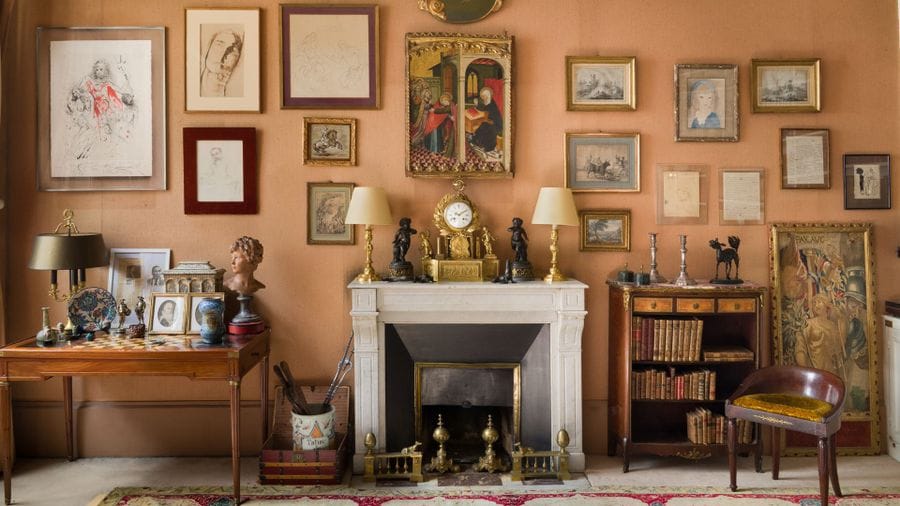
The 11 December sale will bring together more than 200 lots of furniture, paintings and works of art collected in the couple’s Paris apartment. Catherine Laudenbach, who died aged 98, had preserved a significant collection of Asian works of art inherited from her ancestor Philippe Frédéric Clossmann (1817–1867), a leading Bordeaux wine merchant and owner of Château de Malleret in the Bordeaux region. Among the 60 Asian art objects is an exceptional porcelain flask decorated in underglaze blue against a yellow ground, an imperial piece dating to the Yongzheng period, standing nearly 50 cm tall. According to Alice Jossaume, expert at Cabinet Portier & Associés, it is “an exceptionally rare example, impressive for its size, shape, colour and state of preservation”.

A chapter in 20th-century French literary history goes under the hammer
The story of Éditions de La Table Ronde, founded in 1944, is above all that of its creator, Roland Laudenbach (1921–1991), a writer and screenwriter, and Catherine du Vivier de Faÿ-Solignac (1928–2026), his collaborator who later became his wife. Through dozens of manuscripts, typescripts and sets of proofs, hundreds of autograph letters, original photographs, drawings and cover designs, hundreds of inscribed copies and collections of literary journals, the Laudenbach collection traces the close ties the couple forged with the authors they championed, brought back into print and rescued from obscurity.
The name La Table Ronde, suggested by Jean Cocteau, referred to the circle of writers surrounding Roland Laudenbach, a nephew of actor Pierre Fresnay. He became a leading figure in publishing by supporting established writers such as Anouilh, Giono and Morand when their careers were faltering, while offering a springboard to emerging talents such as Roger Nimier and Bernard Frank. In the late 1940s, Parisian intellectual life was dominated by Jean-Paul Sartre, who believed that artists had a duty to engage with political and social issues, constraining literature that sought to exist purely as an artistic expression. Following the resounding success of Antigone, which Jean Anouilh entrusted to the then 23-year-old publisher, the publishing house, together with its literary journal, began its first sallies against the existentialism of Sartre and Beauvoir. Roland Laudenbach became the leader of a literary circle that Bernard Frank dubbed “Les Hussards” (Roger Nimier, Antoine Blondin, Jacques Laurent, Michel Déon and others), writers who championed a literary tradition in opposition to existentialism.

Within this circle, Catherine du Vivier was the glue that held the publishing house together: an indefatigable organiser, a devoted wife and a valued source of support for its authors. This is borne out by an extraordinary dedication from Antoine Blondin in the first edition of Un singe en hiver: “For Catherine, this novel that travelled through the post and which we finished together in the sunlit printing works, and which will remain her tour de force.” The sale tells the story of an independent publishing house that carved out a place alongside Gallimard, Grasset and Le Seuil, building a catalogue that, in Michel Déon’s words, was “a catalogue of discernment, friendship, courage and freedom of thought”.
The rediscovery of an imperial Chinese porcelain flask from the Yongzheng period
Among the 230 lots of furniture and works of art from Catherine Laudenbach’s Paris apartment is a fine collection of 60 Asian art objects. Inherited from the late owner’s great-great-grandfather, Philippe Frédéric Clossmann (1817–1867), a leading Bordeaux wine merchant and owner of Château de Malleret in the Bordeaux region, these objects have remained in the family since the 19th century. Never previously exhibited or published, they were scattered throughout the apartment among the books. Their appearance on the market is set to delight collectors.
The exceptional flask, an imperial object dating to the Yongzheng period (1723–1735), is undoubtedly the major rediscovery within this Asian art collection. Its impressive size (nearly 50 cm tall), its white, blue and yellow palette, its distinctive shape, imperial provenance, excellent state of preservation and rarity - only one comparable example is known - make it an outstanding piece, estimated at €800,000–1,000,000.
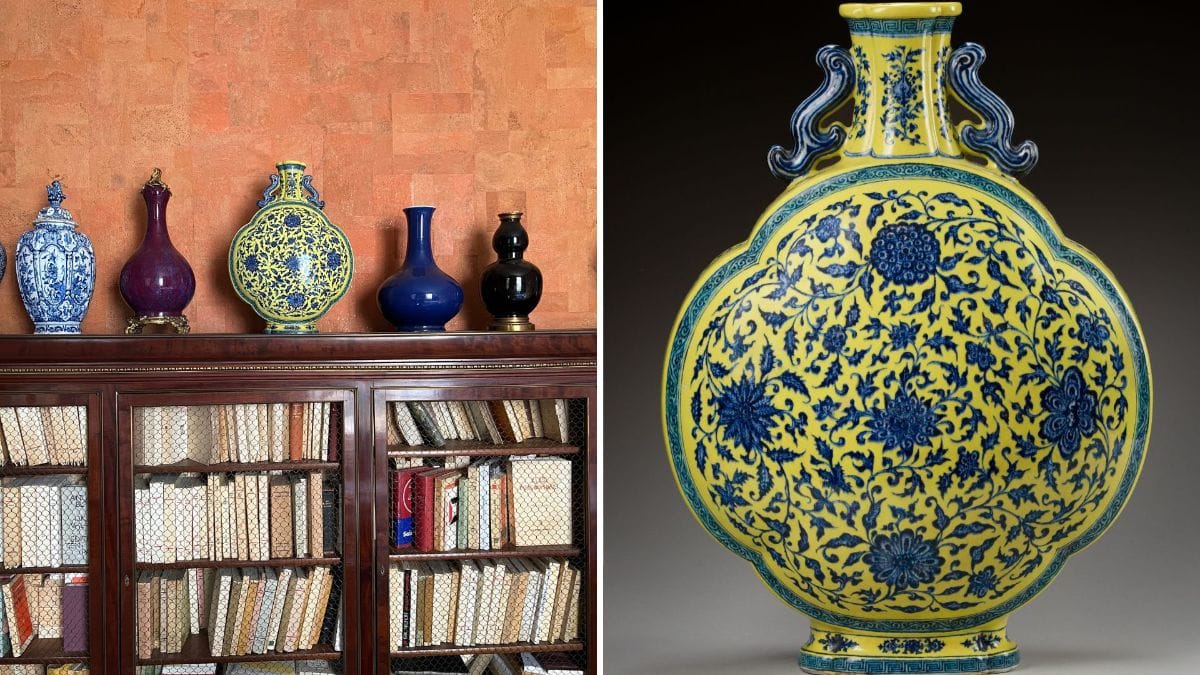
Among the discoveries made by the auctioneers at the top of a bookcase was a rare Yongzheng-period bowl with a pink glaze, one of the earliest monochrome examples in this colour. Two bowls of comparable size are held in the Grandidier collection at the Musée Guimet. Several more common examples, slightly smaller in diameter and decorated with an anhua dragon motif, are held in the Forbidden City in Beijing and the Palace Museum in Taipei.
Catherine Laudenbach, née du Vivier de Faÿ-Solignac, had a cultivated appreciation of fine objects and developed a particular taste for intellectually demanding painting. Her Paris apartment on rue de Penthièvre housed some remarkable works, including two Spanish early paintings, Saint Joachim and Saint Anne at the Golden Gate and The Gathering of the Apostles, as well as a fine painting by Nicolaus Knüpfer (1609–1655), The Apostle Paul Defending Himself at His Trial in Caesarea, also known as The Apostle Paul before Festus and Agrippa. This classical taste in furniture and decorative arts was complemented by modern art, as illustrated by a fine portrait by Lucien-Victor Guirand de Scévola (1871–1950), Portrait of a Woman with a Flowered Headdress, dated 1901.