From Chu Teh-Chun to Fontana: A Collection Assembled at Drouot and Auctioned at Drouot
The objects and works of art from the Parisian apartment of a Chinese couple of art lovers reveal a genuine appreciation for a certain cosmopolitan lifestyle—that of the interwar Café Society—enriched by an Asian perspective. “My parents come from the world of fashion,” their son explains. “They traveled extensively in Europe (Paris, Milan, Florence, London), as well as in Asia and along the East Coast of the United States. The collection evolved as their experiences unfolded. ” Of the approximately 135 lots, 54 come from Parisian public auctions—mostly at Drouot, from some twenty-five auction houses—and together account for nearly two-thirds of the total estimate (over€450,000at the low end).
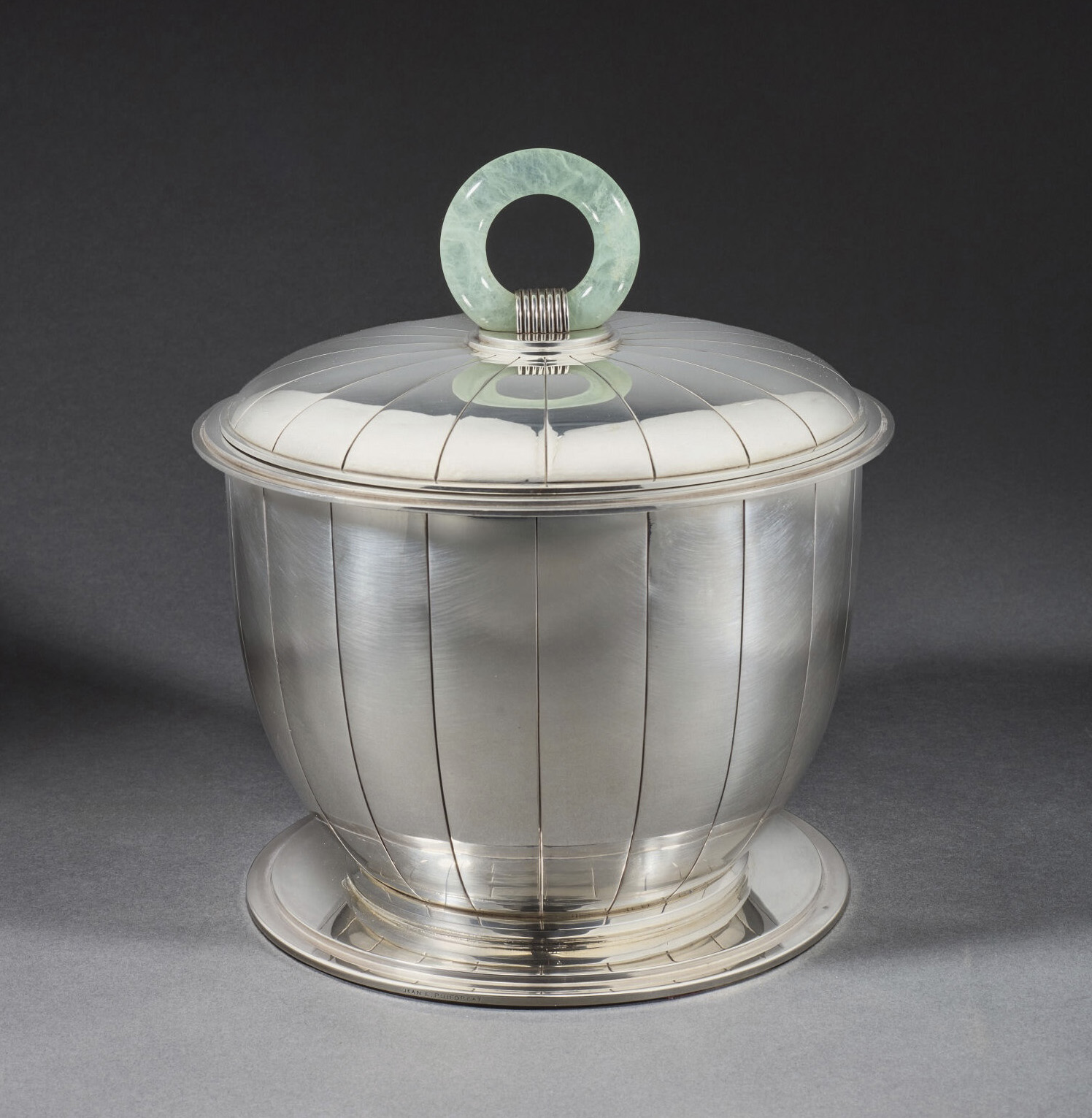
The provenance list reads like a directory of the Parisian art market of the 1990s: Calmels, Loudmer, Binoche, Tajan, Francis Briest, Beaussant-Lefèvre, Piasa, Poulain-Le Fur. The acquisitions began in 1994, notably with a lidded pot with a jade handle signed Puiforcat, from the collection of Mr.and Mrs.Georges Masson, sold by Picard (€12,000–18,000, reproduced on page15), or a chiffonier in the style of Clément Mère (€4,000–6,000) from the collection of dealer and collector Michel Souillac, sold by Poulain-Le Fur.
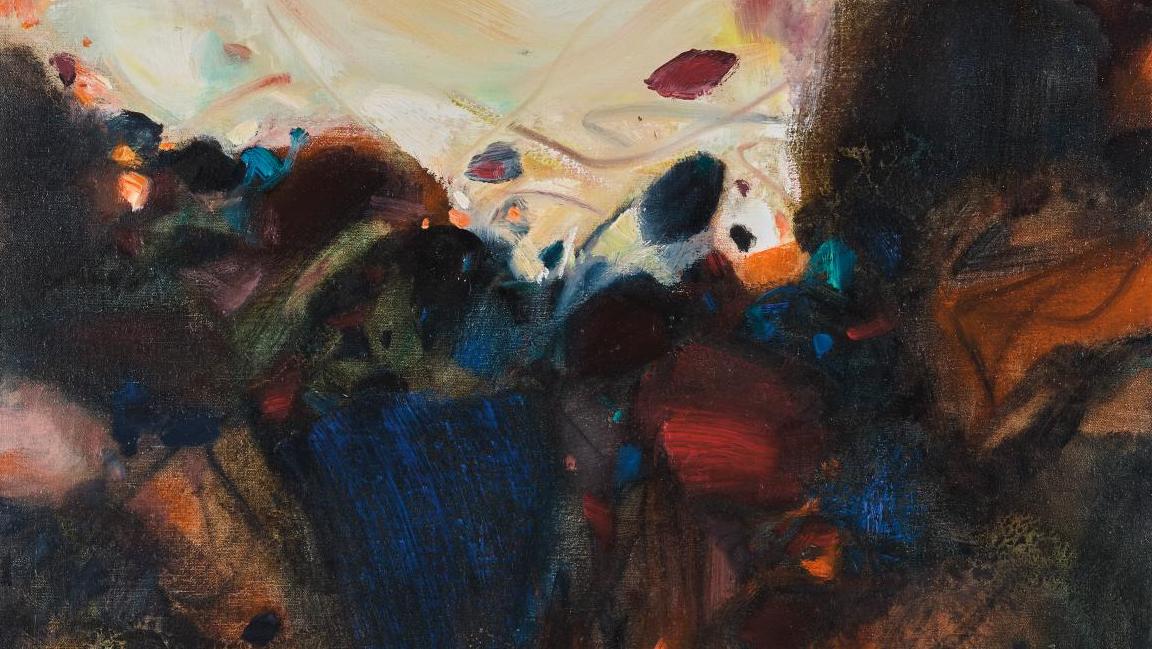
The year 1996 marked a turning point. On March 8, at Binoche, the couple acquired a large gouache by Walasse Ting from the estate of Primrose Bordier, the designer who brought color to French linens (Three Women, gouache on paper, 180x97.5cm,€15, 000–20,000). Sixteen days later, at Calmels, they successfully bid on *Point d’orgue* by Chu Teh-chun (oil on canvas, 73x60cm,€80, 000–120,000, reproduced on the right-hand page), the collection’s centerpiece. This was followed by ten purchases, including two other works by Walasse Ting— *Two Women with Fans* and *Nude *—sold by Guy Loudmer (acrylic and oil pastel on paper mounted on canvas, 43.5x65cm,€3,000–5,000 each), a dressing table and desk that had belonged to actor Yul Brynner (Tajan, €800/1,200), and a drop-leaf secretary desk in palm veneer and Macassar ebony (Francis Briest,€1, 000/3,000).
Estimate: 1,500/1,800€
Two Visions of Abstraction
Another highlight of the sale is the *Concetto spaziale*, Natura by Lucio Fontana (two polished bronze spheres, numbered 301/500, 29x21.9x21.9cm, 1967 edition,€80,000–120,000) comes from the estate of a friend of the couple: the collector Mmede Gavardie. It was acquired from Francis Briest on July 7, 2000. Chu Teh-chun and Fontana share a common rejection of figuration, but not the same conception of abstraction. For Chu Teh-chun, abstraction constitutes the memory of a landscape. Form dissolves, the motif fades as memory wanes, but nature remains: mists, snow, dawns, and flashes of light shine through dark backgrounds. Under the brush, colors become calligraphy. It is an abstraction of continuity, extending both the Chinese literati landscape and Parisian lyrical abstraction without breaking with either. In Fontana’s work, abstraction—more radical—is a concept, a rupture. It is no longer a matter of painting space but of bringing it into existence, by cutting into the canvas or splitting the material. Not really color, not composition, but a gesture, an opening toward the possibility of another place.
Estimate: €12,000–18,000
The Art of Travel
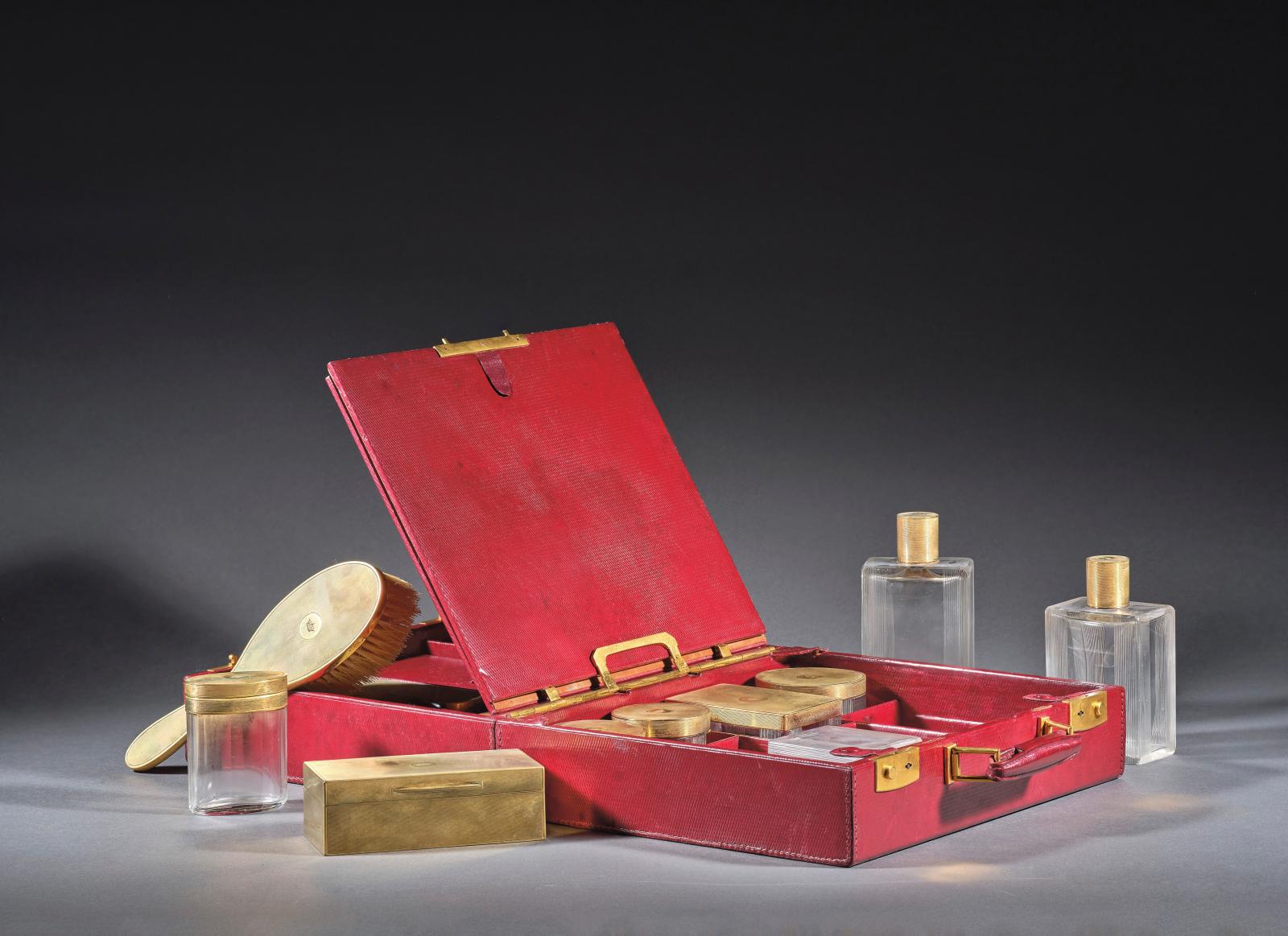
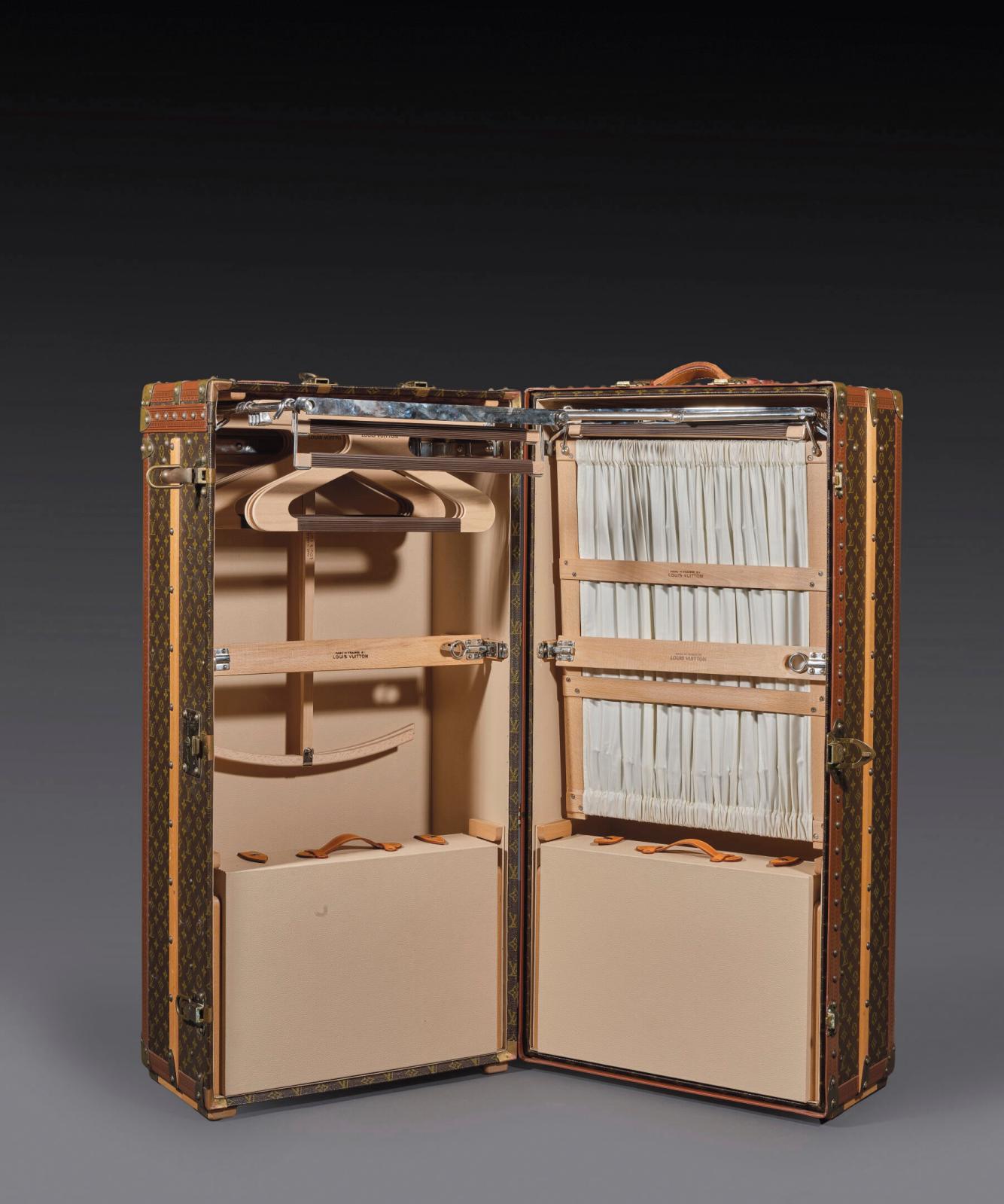
This sense of “elsewhere” begins with travel, which plays an essential role in the lives of these two collectors. Among the most interesting finds is a Cartier toiletries case (shown on the left-hand page,€1,500–1,800), bearing the coat of arms of the Marquise and Marquis Merry del Val, the Spanish monarchy’s ambassador to London from 1913 onward, along with a dedication from their friends in the diplomatic corps dated April 1931. A coincidence of timing? On the 14th of that same month, the proclamation of the Second Spanish Republic brought an end to the monarchy and forced Alfonso XIII into exile. The art of travel would be unthinkable without Louis Vuitton and Hermès.“They were already Louis Vuitton customers back when the brand had only two stores [in Paris and Nice in 1977, ed.],” the collectors’ son adds.“That’s what inspired them to bring fashion to Southeast Asia.” Examples include the Monogram canvas wardrobe trunk (shown on the left-hand page,€12,000–18,000) or two Hermès Birkin 35 bags in crocodileleather(€25,000–40,000and€30, 000–50,000).
Estimate:€12,000–18,000
Puiforcat and Jensen
Tableware remains one of the cornerstones of domestic elegance and could not escape the attention of collectors who cultivate a certain sense of taste. The collection, assembled over the years, juxtaposes two styles of modernism: the French, geometric style, and the Danish, organic style.“The couple nurtured a sincere love for Jean Puiforcat’s creations with their clean lines and geometric structure,” notes Amélie Marcilhac, the auction’s expert. They acquired about fifteen pieces, including a silver champagne bucket (3,090g,€5,000–8,000) and a centerpiece made of mirror panels (silver and silver-plated metal,66cmwide,€8,000–12,000).“A piece,”the expert adds,“that would be nearly impossible to reproduce today given its cost.” Georg Jensen’s designs also embody a certain minimalism, softened by the roundness of their forms. These curves are also found in the goblet designed by Henning Koppel, which won a gold medal at the Milan Triennale in 1951 (silver, model 980, h.15cm, diam. 39cm, 3,274g,€9,000–12,000). The candlesticks by Harald Nielsen (hammered silver with five arms, model 537A, 1,025 and 1,022g,€5,000–8,000) and the pitcher by Johan Rohde (€ 800–1,200), purchased in June 2005 from Beaussant-Lefèvre, bear the name of Simone Simon, the legendary star of Jacques Tourneur’s*La Féline *. The furniture, as Amélie Marcilhac herself admits, “may not be the most striking pieces in the auction, but they are nonetheless of fine craftsmanship.” Collectors will have the opportunity to bid on a Macassar ebony sideboard, also from the Michel Souillac collection (92.5x150x46cm,€4,000–6,000), a dining table by Jules Leleu (h.72, diam. 114cm,€1,000–1,500), or a pair of Art Deco sideboards in Macassar ebony and Bakelite (h.119cm,€3, 000–5, 000).
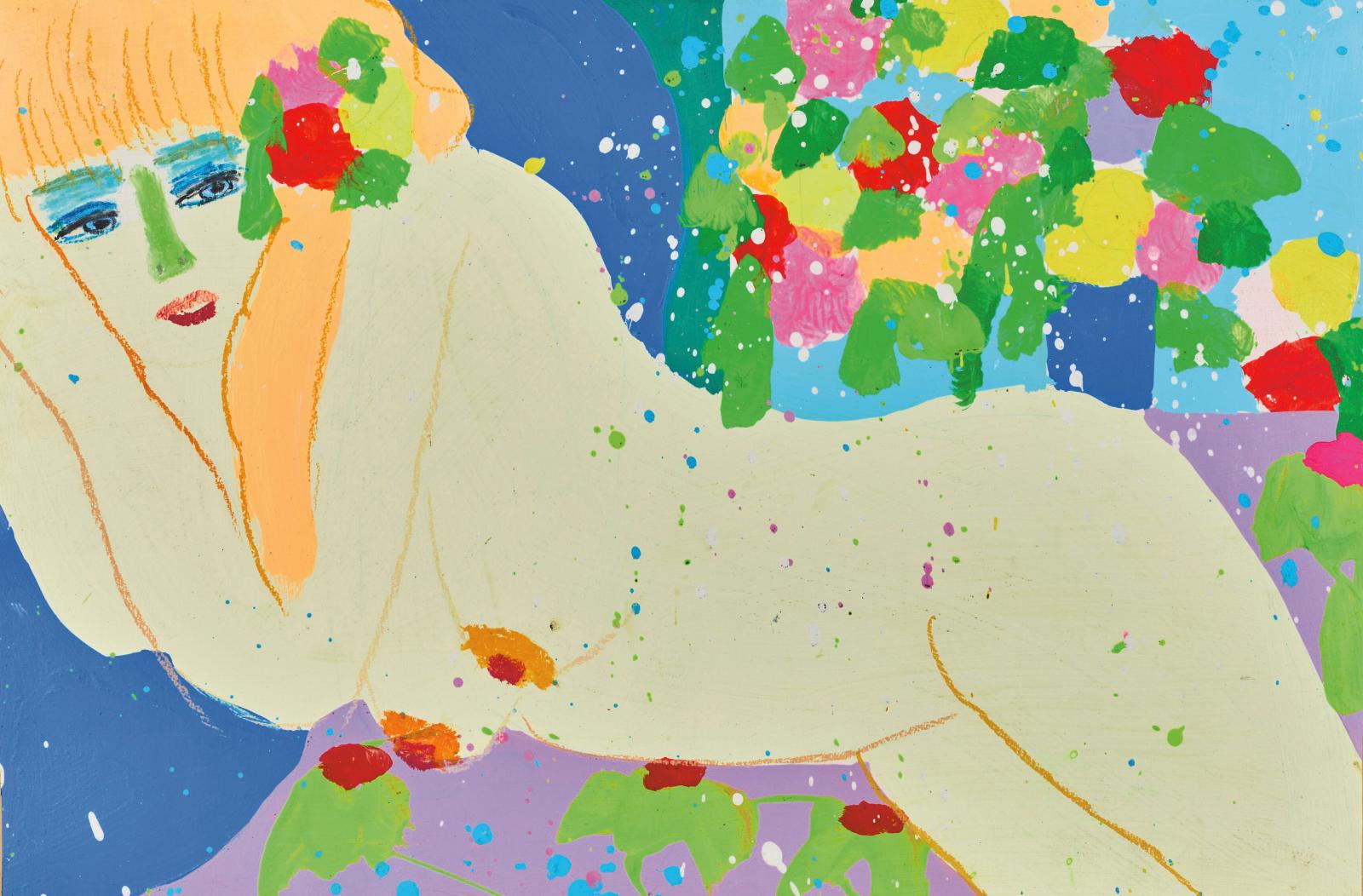
Estimate:€3
© Estate of Walasse Ting / ADAGP, Paris
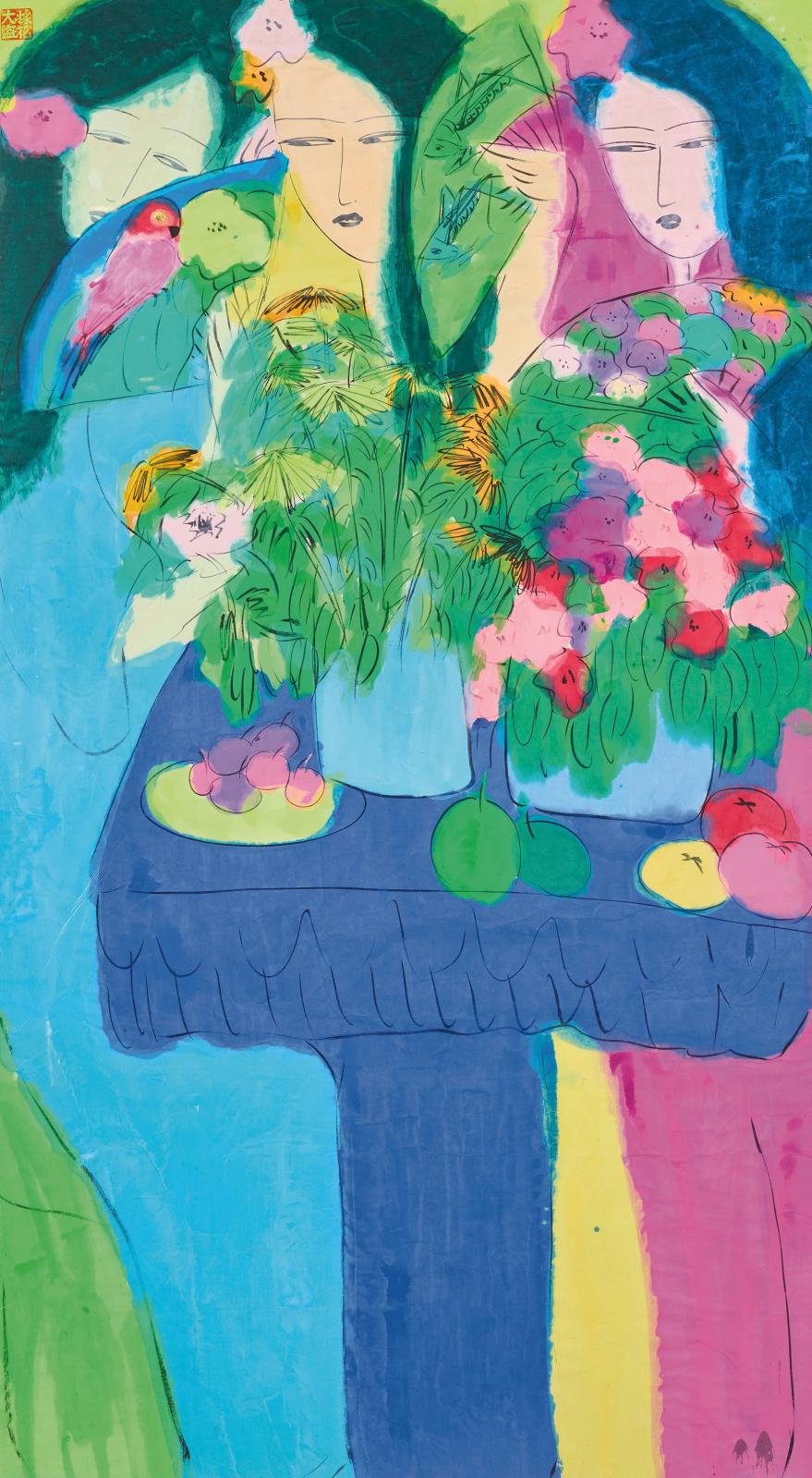
Estimate:€15,000–20,000
© Estate of Walasse Ting / ADAGP, Paris 2026