
VENDREDI 5 JUIN 2026 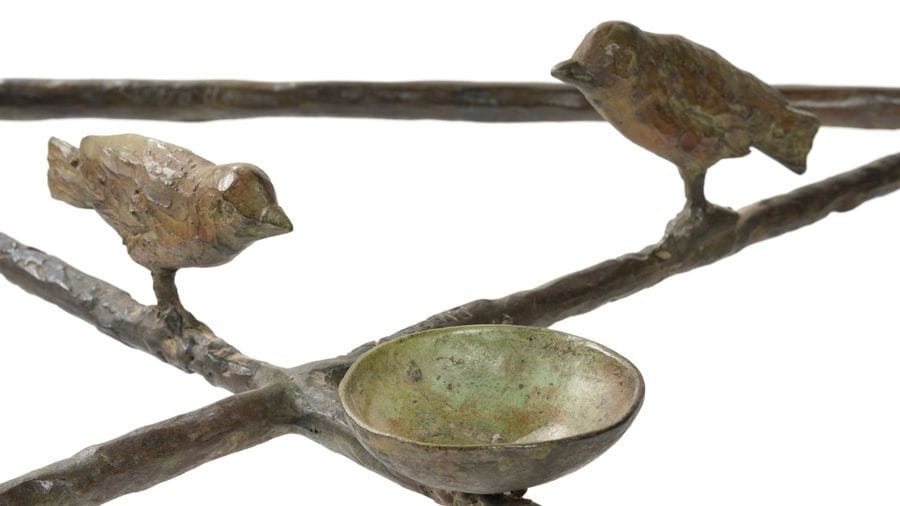
A Major Modern Art Collection Unveiled at Hôtel Drouot
D rouot Estimations presents at the Hôtel Drouot an exceptional collection of modern art, appearing for the first time at auction : 50 previously unseen works by Joan Miró, Alberto Giacometti, Diego Giacometti, Balthus, Richard Serra, Pablo Picasso and Jean-Paul Riopelle. These leading figures of 20th-century art include several artists who made France their chosen ground for creation and artistic expression.
Assembled from the 1970s onwards, this remarkable collection tells the story of a lifetime, where a deep engagement with art is closely interwoven with friendships formed with some of the most important contemporary artists. The collector’s choices reveal a profound appreciation – and most likely a lasting attachment – both to the artists themselves and to the galleries that supported them.
A major group of works by Diego Giacometti
A highlight of the sale is an exceptional group of eight works by Diego Giacometti, among the most significant ensembles by the artist ever to come to market. These sculptural pieces of furniture, infused with vegetal inspiration, blend poetry and wit, subtly subverting functional design through a playful, animated bestiary. This light, at times almost whimsical vocabulary attracted some of the greatest collectors of the 20th century, including Hubert de Givenchy, the Guerlain family, Aimé Maeght and Hélène Rochas.
Among the standout pieces is the console La Promenade des amis, conceived in 1976, which unfolds as a delicate narrative scene: two dogs and a horse gathered around a tree in a composition that feels both intimate and lightly humourous. Diego Giacometti himself explained that the idea came to him from “a client who organised charity sales for animal welfare. That gave me the idea of La Promenade des amis: a horse with three small dogs – one watering the tree, another sniffing it.”
This narrative dimension runs through several other works in the group, including the sculptural table Feuilles aux oiseaux et aux grenouilles (1980), where two birds appear to lean towards a small dish (est. €400,000–600,000), as well as two double-tier side tables, their uprights topped with frogs and one horizontal element inhabited by an owl (est. €200,000–300,000 each).
The low table Berceau aux chats (1970) reflects the evolution of Giacometti’s language, moving from formal restraint towards the introduction of animal figures that bring the structure to life (est. €400,000–600,000). Alongside these rare pieces stands the celebrated Chat maître d’hôtel, mischievous yet poised and elegant, in the second version of the 1967 model (est. €120,000–150,000). The same imaginative bestiary extends to lighting, with the lamp base Au Hibou, second version of the 1980 model, in which the bird of prey sits beside a small dish (est. €100,000–150,000).
Among the standout pieces is the console La Promenade des amis, conceived in 1976, which unfolds as a delicate narrative scene: two dogs and a horse gathered around a tree in a composition that feels both intimate and lightly humourous. Diego Giacometti himself explained that the idea came to him from “a client who organised charity sales for animal welfare. That gave me the idea of La Promenade des amis: a horse with three small dogs – one watering the tree, another sniffing it.”

This narrative dimension runs through several other works in the group, including the sculptural table Feuilles aux oiseaux et aux grenouilles (1980), where two birds appear to lean towards a small dish (est. €400,000–600,000), as well as two double-tier side tables, their uprights topped with frogs and one horizontal element inhabited by an owl (est. €200,000–300,000 each).
The low table Berceau aux chats (1970) reflects the evolution of Giacometti’s language, moving from formal restraint towards the introduction of animal figures that bring the structure to life (est. €400,000–600,000). Alongside these rare pieces stands the celebrated Chat maître d’hôtel, mischievous yet poised and elegant, in the second version of the 1967 model (est. €120,000–150,000). The same imaginative bestiary extends to lighting, with the lamp base Au Hibou, second version of the 1980 model, in which the bird of prey sits beside a small dish (est. €100,000–150,000).

The great masters of the 20th century
Beyond this ensemble, the collection brings together a remarkable selection of major 20th-century artists. It opens with a 1955 abstract work by Jean-Paul Riopelle, reflecting the artist’s growing international recognition at the time, shaped by his links with the New York scene and his relationship with dealer Pierre Loeb, who acquired a significant part of his output (est. €150,000–200,000).
Two works by Joan Miró, Sans titre (June 1937) and La toilette de Violette (18 July 1938), mark a pivotal moment in his practice, moving between figuration and abstraction as he firmly distanced himself from pictorial conventions. Both works travelled from New York to the Seibu Collection in Tokyo before being shown at Galerie Lelong in Paris, reflecting an international exhibition history of distinction (est. €200,000–300,000 and €250,000–350,000).
This trajectory extends into sculpture with L’Arc, a bronze model associated with the Fondation Maeght, here presented as an artist’s proof with a green patina, cast circa 1981–1982 (est. €150,000–200,000).
The dialogue between media continues with Richard Serra’s Stratum J (2006), in which the artist translates the physical tension of his sculptural work into drawing, creating a dense surface charged with material force (est. €150,000–200,000).
Finally, Balthus’s Étude pour Le Rêve 1 (1956) belongs to his celebrated series devoted to this recurring theme, developed in his studio at the Château de Chassy, where he settled in 1953 (est. €40,000–60,000).
Two works by Joan Miró, Sans titre (June 1937) and La toilette de Violette (18 July 1938), mark a pivotal moment in his practice, moving between figuration and abstraction as he firmly distanced himself from pictorial conventions. Both works travelled from New York to the Seibu Collection in Tokyo before being shown at Galerie Lelong in Paris, reflecting an international exhibition history of distinction (est. €200,000–300,000 and €250,000–350,000).

This trajectory extends into sculpture with L’Arc, a bronze model associated with the Fondation Maeght, here presented as an artist’s proof with a green patina, cast circa 1981–1982 (est. €150,000–200,000).
The dialogue between media continues with Richard Serra’s Stratum J (2006), in which the artist translates the physical tension of his sculptural work into drawing, creating a dense surface charged with material force (est. €150,000–200,000).
Finally, Balthus’s Étude pour Le Rêve 1 (1956) belongs to his celebrated series devoted to this recurring theme, developed in his studio at the Château de Chassy, where he settled in 1953 (est. €40,000–60,000).
Picasso ceramics
The collection also features a group of six ceramics by Picasso made at the Madoura workshop: plates, dishes, vases and pitchers, produced within the prolific collaboration between the artist and Georges and Suzanne Ramié. Picasso explored the expressive possibilities of this medium with great curiosity and freedom. These works bring together familiar motifs from his visual universe, where fauns, faces and owls populate everyday objects.
Highlights include Bouteille gravée (1954), a white earthenware piece (est. €15,000–20,000), a dish with a white owl on a red ground dated 25 March 1957 (est. €15,000–20,000), and a plate featuring a faun’s face on a red ground dated 28 June 1955 (est. €5,000–7,000).
>> Download the press release (English version)
evenement du 28 octobre au 9 novembre 2026
"Nouveau Regard" : A Selection of Works By Judith Touitou
evenement du 31 octobre au 11 décembre 2026
Un Samedi à Drouot | Découvrez l’univers fascinant des enchères
annonce 29 octobre 2026


