The Singular View of Charlotte de Saint-Gervais
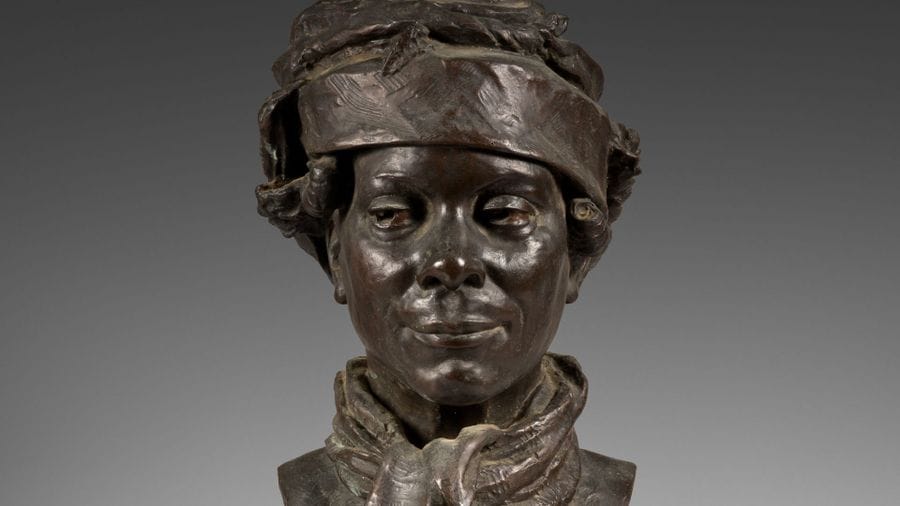
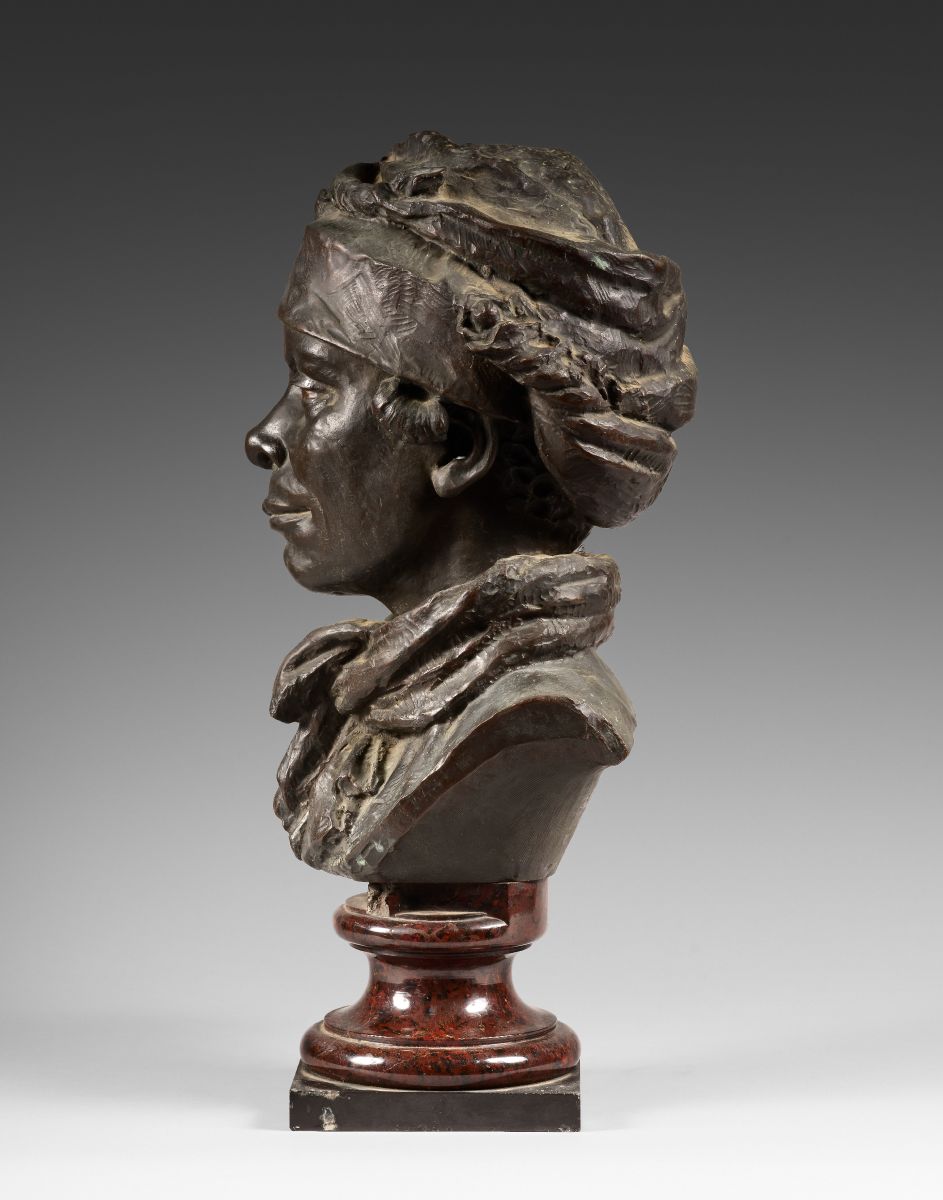
It was under the official title Négresse that this decidedly modern bust was first exhibited at the Salon of 1876. Difficult to accept in the early twenty-first century, this title given to the portrait of a young African woman with an impertinent gaze and a mischievous smile, dressed with distinctly Parisian elegance, must nevertheless be understood within its post-abolitionist political and historical context of the French Third Republic, when ignorance, racism and derogatory representations unfortunately remained widespread.
Created by Charlotte de Saint-Gervais—who would become the Countess de La Salle following her marriage to Georges Seguin de La Salle in 1881—this bust marked the official Salon debut of a young sculptor of aristocratic background, trained in the studio of the renowned Mme Léon Bertaux, a leading advocate for women’s access to artistic education. Between 1876 and 1898, Charlotte de Saint-Gervais exhibited regularly at the major Paris Salons, where she presented primarily portrait busts, establishing a particular specialisation in this conventional sculptural genre.

Yet despite the presentation of this visionary early work, the sculptor never achieved lasting recognition. Which illustrate just how revolutionary—even iconoclastic—this bust of an African woman must have appeared when it was exhibited fourteen years earlier by an artist who was barely sixteen years old (she is believed to have been born in 1860).
The bust depicts a young woman wearing a high turban whose broad bands of fabric, combined with the ringlets framing her face, establish a subtle dialogue between “exotic” headwear and Parisian elegance. Animated by a slight smile and a sidelong glance tinged with irony, the face moves beyond simple ethnographic typology to suggest temperament and individuality, expressed through a restrained yet unmistakable impertinence. Around her neck, a crossed scarf recalls the outdoor fashions worn by elegant Parisian women of the period. The bronze bust rests on a veined reddish-brown marble socle; the combination of this luxurious base and a vigorous modelling—almost Impressionistic in its treatment of folds and surfaces—anchors the work firmly within the sculptural modernity of the 1870s.
Within the post-abolitionist context of the 1860s–1880s, European curiosity about the “Other” manifested itself in many forms, from the founding of the Société d’Anthropologie de Paris in 1859 to the display of peoples from around the world at international exhibitions. This representation of an African woman stands at the intersection of several traditions: the still-prevalent ethnographic and decorative sculpture promoted by Charles Cordier, and the more dramatic and politically charged approach inaugurated by Jean-Baptiste Carpeaux with his Négresse, later retitled Why Born Enslaved?
Compared with Carpeaux, however, Charlotte de Saint-Gervais introduces a genuine iconographic shift. She abandons the explicit attributes of slavery—ropes, violent torsion, compressed flesh—and rejects any form of sensationalised eroticism in favour of a dignified figure whose expressiveness is concentrated in the face and hairstyle, where both otherness and modernity coexist. Far from being an anonymous “type”, the young African woman acquires the qualities of a true portrait: a distinctive attitude, an assured elegance and an almost worldly presence, even if the Salon title perpetuated the racial categorisation of its time.
This evolution parallels developments in painting. Cézanne’s Scipio the Black (c. 1866–1868) already endowed its African sitter with an unprecedented physical and psychological presence. In Olympia (1863, exhibited at the Salon of 1865), Manet gave the African servant Laure a striking visibility alongside the European courtesan. In 1870, Bazille’s Young Woman with Peonies (formerly titled Negress with Peonies) presented a stylishly dressed Black woman associated with a refined floral motif, already far removed from images of servitude alone. Closer still to the present bust is Fernand Cormon’s Young African Woman in Profile (Musée d’Orsay), a figure of remarkable nobility rendered with gravity and close attention to the modelling of the hair and torso.
In this context, Négresse no. 3594 at the Salon of 1876 emerges as a pivotal work in the history of the representation of Black sitters in the late nineteenth century. Produced by a sculptor trained in a progressive workshop, it translates into the academic medium of the portrait bust many of the questions explored by modern painters such as Manet, Cézanne, Bazille and Cormon. It makes the Black female figure a subject in her own right—one shaped by the racial ideologies of its time yet endowed with a clearly perceptible individuality. Through the vigour of its modelling, the sophistication of its turbaned hairstyle and the deliberate ambiguity between “African type” and Parisian elegance, this bust demonstrates, from Charlotte de Saint-Gervais’s very first Salon appearance, the ambition of a sculptor determined to engage with a subject previously dominated by major male artists, approaching it with a gaze that was at once critical, worldly and deeply humanist.