DIENSTAG, 7. JULI 2026 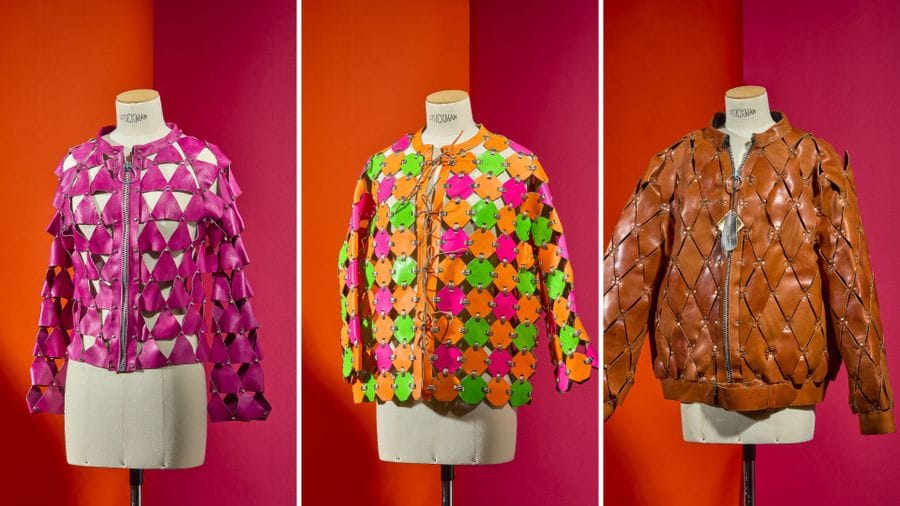
Thirty-Eight Rare Paco Rabanne Pieces from the 1960s Head to Auction
O n 7 July, Audap & Associés will present at the Hôtel Drouot a rare group of 38 Paco Rabanne pieces created between 1967 and 1969 and authenticated by Claire Chassine-Lambert. Preserved for almost sixty years in the workshops of Raoul Lalet, these jackets, coats, accessories and prototypes constitute an exceptional testament to one of the most daring periods in fashion history.
Trained as an architect, Paco Rabanne (1934–2023) profoundly transformed the conventions of 1960s haute couture. Rejecting traditional materials and conventional techniques, he introduced previously unseen materials into fashion, including aluminium, plastic, paper, cut leather, knitted fur and industrial textiles. Far removed from classical dressmaking, his approach resembled that of an engineer or constructor, with rivets, clips, rings and mechanical assemblies replacing thread and needle.
To pursue these experiments, the designer surrounded himself with a network of industrialists, technicians and craftsmen capable of meeting the challenges posed by these innovative materials. Among them was Maison Lalet, founded in Limoges in 1904. Originally specialising in the manufacture of shoe shanks, highly prized by bootmakers of the period, the company gradually developed a recognised expertise in leatherworking. Under the direction of Raoul Lalet and his son Martial Jouandou, the workshops perfected riveting techniques that made it possible to assemble hundreds of geometric leather elements while preserving both flexibility and durability.
The collaboration between Paco Rabanne and the Lalet workshops, likely initiated through Pierre Cardin, gave rise to some of the couturier’s most iconic creations. This sale brings together a number of exceptional pieces originating directly from these workshops and bearing witness to this pivotal partnership. They include finished garments, factory-fresh examples preserved with their original labels, and several prototypes developed by the design office of the Heller brand, a continuation of the Lalet enterprise later overseen by Christian Munier, the founder’s son-in-law.
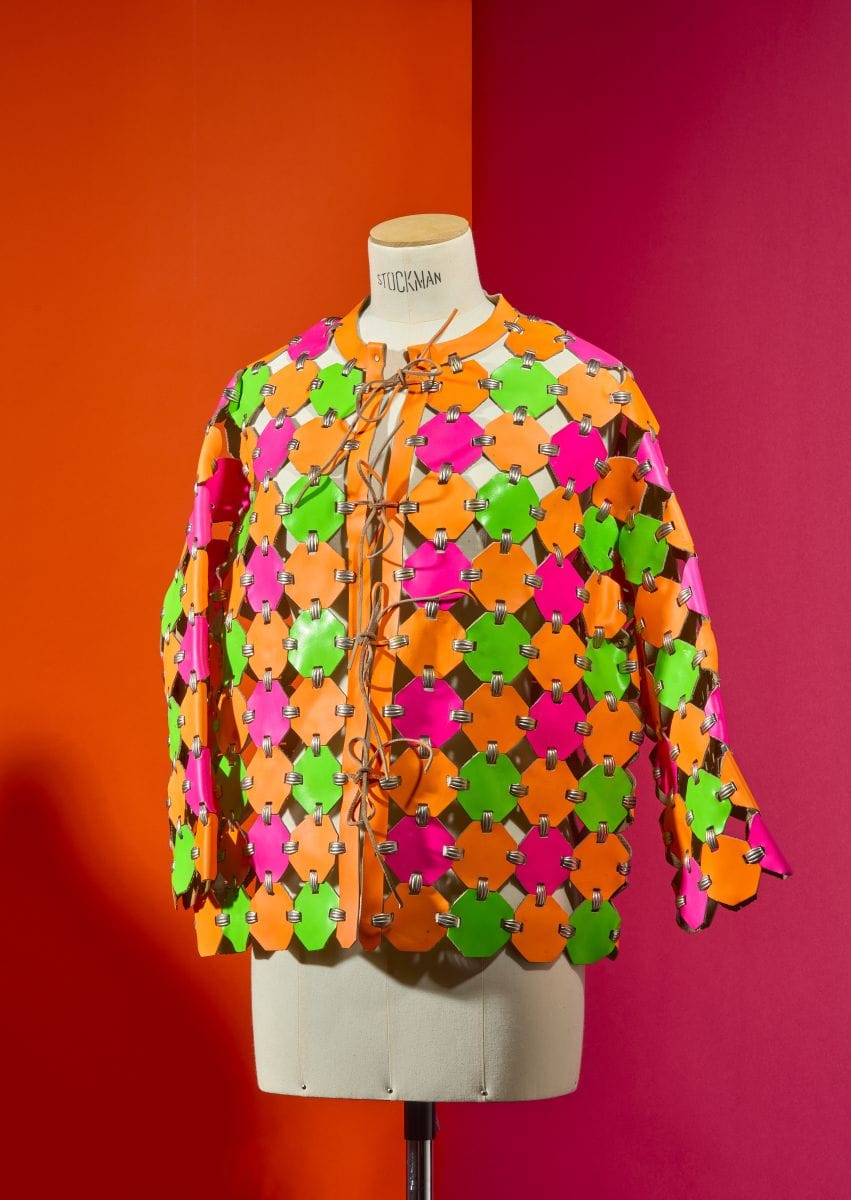
Among the highlights are two spectacular “Peru” jackets composed of fluorescent orange, pink and green octagonal leather discs connected by metal claws. True manifestos of the Paco Rabanne aesthetic, they are respectively estimated at €3,000–5,000.
The sale also includes several examples of the “Vitrail” models, created from openwork riveted leather triangles in vivid shades of orange, yellow, raspberry, blue and burgundy. These jackets, some of which retain their original labels, are each estimated at €700–900. Coats from the same series, whose airy constructions evoke both architecture and chain mail, are expected to achieve €600–800 per lot.
Further illustrating the ingenuity of the Lalet workshops are several natural leather jackets composed of diamond-shaped elements assembled either with rivets or metal rings, showcasing different variations of the techniques developed for Paco Rabanne. They are estimated at €800–1,200.
The ensemble is complemented by a remarkable group of prototypes, including boots, shoe designs, berets and various accessories conceived according to the same geometric principles. Preserved with their original workshop markings, these objects provide a rare insight into the couturier’s creative process. Each shoe prototype is estimated at €100–150, the berets at €120–150 and the boots at €150–200.
Through their direct provenance, previously unseen nature and considerable documentary significance, these pieces shed new light on the technical collaborations that enabled Paco Rabanne to revolutionise the fashion of his era. They serve as a reminder that behind the image of the visionary couturier stood a network of French artisans and companies whose expertise helped make possible some of the most radical creations of the twentieth century.
To pursue these experiments, the designer surrounded himself with a network of industrialists, technicians and craftsmen capable of meeting the challenges posed by these innovative materials. Among them was Maison Lalet, founded in Limoges in 1904. Originally specialising in the manufacture of shoe shanks, highly prized by bootmakers of the period, the company gradually developed a recognised expertise in leatherworking. Under the direction of Raoul Lalet and his son Martial Jouandou, the workshops perfected riveting techniques that made it possible to assemble hundreds of geometric leather elements while preserving both flexibility and durability.
The collaboration between Paco Rabanne and the Lalet workshops, likely initiated through Pierre Cardin, gave rise to some of the couturier’s most iconic creations. This sale brings together a number of exceptional pieces originating directly from these workshops and bearing witness to this pivotal partnership. They include finished garments, factory-fresh examples preserved with their original labels, and several prototypes developed by the design office of the Heller brand, a continuation of the Lalet enterprise later overseen by Christian Munier, the founder’s son-in-law.
Among the highlights are two spectacular “Peru” jackets composed of fluorescent orange, pink and green octagonal leather discs connected by metal claws. True manifestos of the Paco Rabanne aesthetic, they are respectively estimated at €3,000–5,000.
The sale also includes several examples of the “Vitrail” models, created from openwork riveted leather triangles in vivid shades of orange, yellow, raspberry, blue and burgundy. These jackets, some of which retain their original labels, are each estimated at €700–900. Coats from the same series, whose airy constructions evoke both architecture and chain mail, are expected to achieve €600–800 per lot.
Further illustrating the ingenuity of the Lalet workshops are several natural leather jackets composed of diamond-shaped elements assembled either with rivets or metal rings, showcasing different variations of the techniques developed for Paco Rabanne. They are estimated at €800–1,200.
The ensemble is complemented by a remarkable group of prototypes, including boots, shoe designs, berets and various accessories conceived according to the same geometric principles. Preserved with their original workshop markings, these objects provide a rare insight into the couturier’s creative process. Each shoe prototype is estimated at €100–150, the berets at €120–150 and the boots at €150–200.
Through their direct provenance, previously unseen nature and considerable documentary significance, these pieces shed new light on the technical collaborations that enabled Paco Rabanne to revolutionise the fashion of his era. They serve as a reminder that behind the image of the visionary couturier stood a network of French artisans and companies whose expertise helped make possible some of the most radical creations of the twentieth century.