FREITAG, 17. APRIL 2026 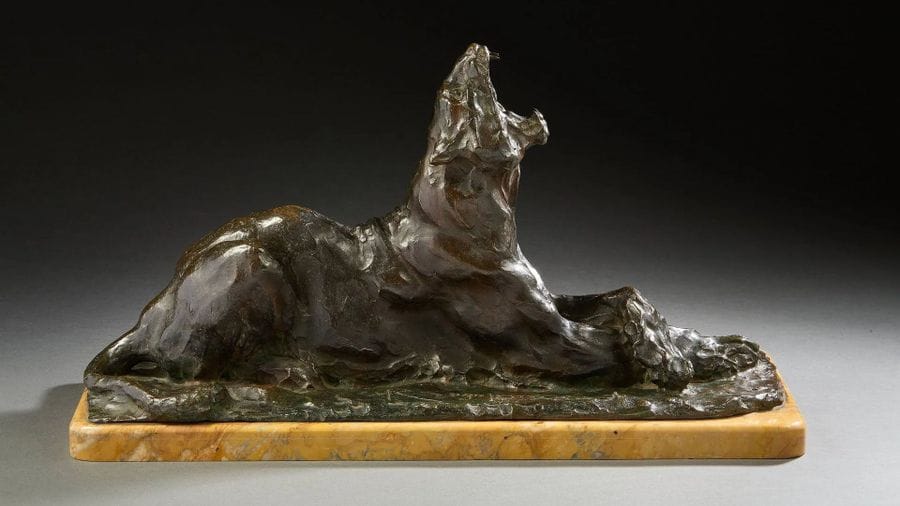
A Rembrandt Bugatti Bronze Takes Centre Stage in an Eclectic Sale
T he auction house Delon-Hoebanx will present, on 17 April, a sale of Old Master and modern paintings, furniture and works of art, whose leading lot promises to make a strong impression.
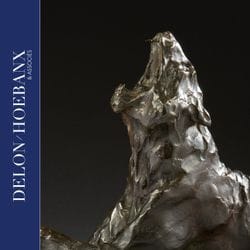
This bronze by Rembrandt Bugatti, entitled Yawning Recumbent Lioness (circa 1903–1904), is emblematic of the work of this artist, deeply fascinated by animals (lot 92, estimate: €250,000–€350,000). Between 1903 and 1908, Bugatti discovered and closely studied the wild animals of the Ménagerie of the Jardin des Plantes. There, he observed big cats in particular, seeking to capture not only their anatomy, but also their behaviour, mood and even their breathing.
This bronze cast captures a moment of striking simplicity: a reclining lioness in the act of yawning. In doing so, it conveys the animal’s latent power, expressed through an everyday gesture that is at once profoundly human and instinctively animal. The work reflects Bugatti’s desire to depict animals in their most truthful state, far removed from symbolism, combining careful observation, emotional sensitivity and technical virtuosity..
Among the paintings, a fine early study by Edgar Degas, The Daughter of Jephthah, circa 1860, stands out. It is likely the final painted study before the execution of the painting now held at the Smith College Museum of Art in the United States (lot 60, estimate: €50,000–€80,000). Also noteworthy is a vibrant Divisionist landscape by Henri Martin, Young Shepherdess by the Seaside, conceived as a preparatory work for a commission of four mural paintings for the apartment of a prominent Parisian doctor. In these compositions, Martin explores the theme of the Golden Age, a central Symbolist subject also treated by Signac and Cross.
The sale also offers a remarkable highlight in the field of manuscripts, with an illuminated Book of Hours on parchment, produced in Paris around 1415–1420, known as the “Heures Ollivier”. Its five large miniatures are attributable to the Master of the Cité des Dames, and the manuscript remains preserved in its original interlaced binding (lot 157, estimate: €40,000–€60,000).

This bronze cast captures a moment of striking simplicity: a reclining lioness in the act of yawning. In doing so, it conveys the animal’s latent power, expressed through an everyday gesture that is at once profoundly human and instinctively animal. The work reflects Bugatti’s desire to depict animals in their most truthful state, far removed from symbolism, combining careful observation, emotional sensitivity and technical virtuosity..
Among the paintings, a fine early study by Edgar Degas, The Daughter of Jephthah, circa 1860, stands out. It is likely the final painted study before the execution of the painting now held at the Smith College Museum of Art in the United States (lot 60, estimate: €50,000–€80,000). Also noteworthy is a vibrant Divisionist landscape by Henri Martin, Young Shepherdess by the Seaside, conceived as a preparatory work for a commission of four mural paintings for the apartment of a prominent Parisian doctor. In these compositions, Martin explores the theme of the Golden Age, a central Symbolist subject also treated by Signac and Cross.

The sale also offers a remarkable highlight in the field of manuscripts, with an illuminated Book of Hours on parchment, produced in Paris around 1415–1420, known as the “Heures Ollivier”. Its five large miniatures are attributable to the Master of the Cité des Dames, and the manuscript remains preserved in its original interlaced binding (lot 157, estimate: €40,000–€60,000).