FREITAG, 13. FEBRUAR 2026 
This Week in La Gazette Drouot : René Lalique's art deco Poissons vase, a classic of glass art
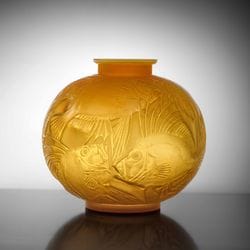
C reated in 1921, René Lalique's Poissons vase is one of the longest-lasting models in the catalog, with sixteen years of continuous production. Made of opalescent blown-molded glass, it was produced in several chromatic variants.
By Vanessa Schmitz-Grucker
Designed in 1921, the Poissonsvase belongs to the series of large vases developed by René Lalique in the early 1920s, when the glassworks in Wingen-sur-Moder - in northern Alsace - became the center of production structured around blow-molding and patinas. At this time, Lalique favored compact shapes, without a main face, designed to be seen in volume.
The decoration was no longer applied as an autonomous motif, but integrated into the very structure of the object, according to a logic made possible by blow-molded glass. Our vase features a slightly ovoid body, topped by a short neck and resting on a discreet heel.
Read the full version of René Lalique's art deco Poissons vase, a classic of glass art in La Gazette Drouot
Designed in 1921, the Poissonsvase belongs to the series of large vases developed by René Lalique in the early 1920s, when the glassworks in Wingen-sur-Moder - in northern Alsace - became the center of production structured around blow-molding and patinas. At this time, Lalique favored compact shapes, without a main face, designed to be seen in volume.
The decoration was no longer applied as an autonomous motif, but integrated into the very structure of the object, according to a logic made possible by blow-molded glass. Our vase features a slightly ovoid body, topped by a short neck and resting on a discreet heel.
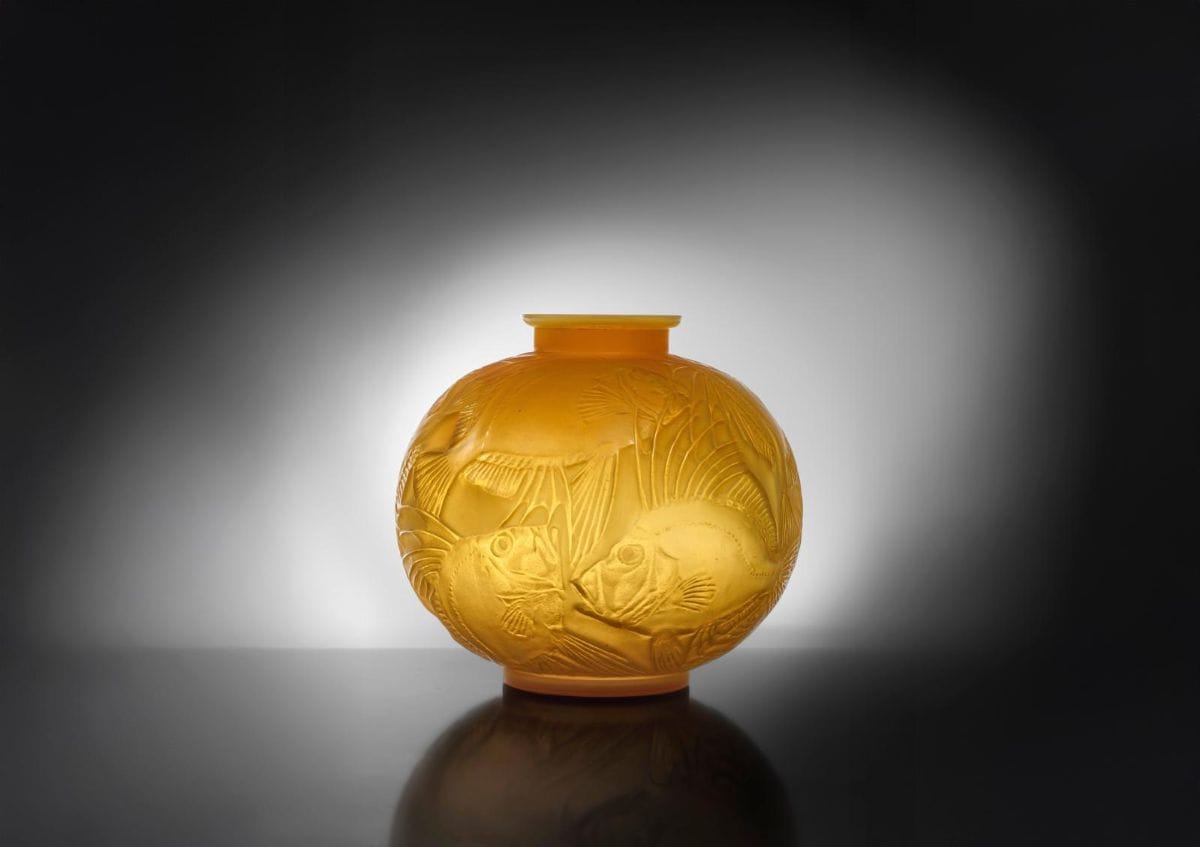
The decoration unfolds in a continuous frieze : large, stylized fish in high relief alternate with seaweed and simplified aquatic elements. The design is based on legible masses and assertive contours. It's precisely the technique of glass-blowing that produces the thick walls and deep relief characteristic of this phase of production.
The model is available in several variants. Opalescent versions exploit the diffusion of light in the glass mass, with variable effects depending on the lighting. Others are tinted in the mass: amber, yellow, orange-red, more rarely smoked or green.
The model is available in several variants. Opalescent versions exploit the diffusion of light in the glass mass, with variable effects depending on the lighting. Others are tinted in the mass: amber, yellow, orange-red, more rarely smoked or green.
Discover a world of art and auctions with La Gazette Drouot
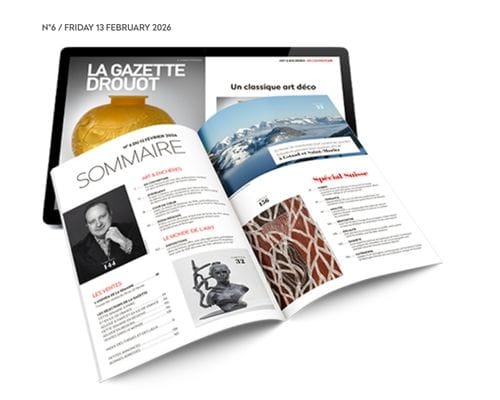
Every week, since 1891, La Gazette Drouot has been the authoritative weekly for public auctions of furniture, paintings and objets d'art. Our issues published contain thousands of articles which explain, decipher and analyse objects as well as their market, while others give leading figures a forum for sharing their passion. And not forgetting the cultural news, enlightened by in-depth articles on diverse subjects, often published for the first time.
You too can enjoy this wealth of information and images by picking up La Gazette Drouot.
You too can enjoy this wealth of information and images by picking up La Gazette Drouot.