DIENSTAG, 17. FEBRUAR 2026 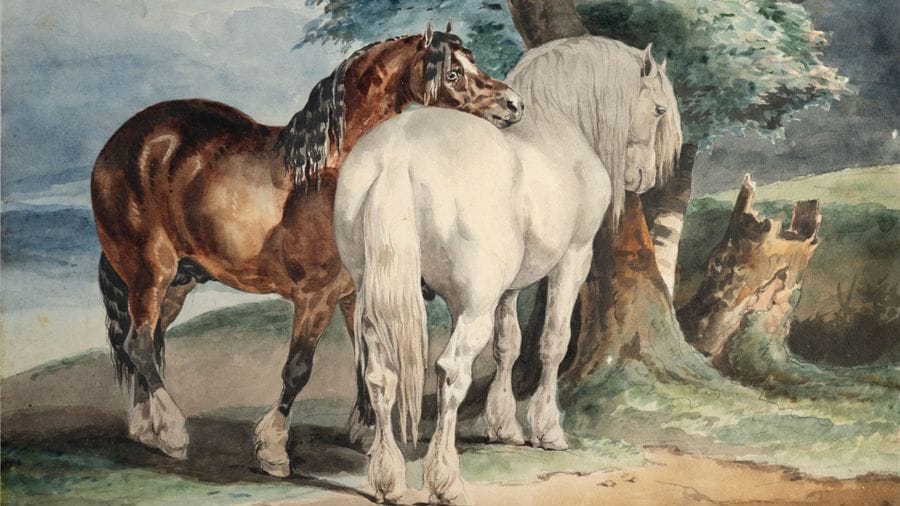
This study can be compared to the painting held in the Musée des Beaux-Arts in Dijon, also entitled Chevaux au pâturage. The Dijon painting gave rise to a lithograph, titled Chevaux flamands, dated 1822. Several differences can be observed, notably in the position of the white horse’s neck — raised here, lowered in both the painting and the lithograph — as well as in the motif of the two trees.
Elusive yet universally renowned, an admirer of Ingres and Raphael before being hailed as the leading figure of the Romantic movement, Géricault was a man of contrasts. Around his name grew the legend of the misunderstood artist, whose masterpiece The Raft of the Medusa, exhibited at the Salon in 1819, was almost unanimously rejected by critics. Mourned by a wide circle of artists after his death, tributes soon multiplied: lamented by Delacroix, hailed by Balzac as a “man of talent”, the painter never lived to witness his own success. Majestic lions, compelling portraits and fiery horses populate his painted and lithographic œuvre.
A newly discovered drawing by Théodore Géricault
V illemur Art is unveiling a previously unknown drawing by the French Romantic painter Théodore Géricault, to be offered for sale on 17 February at the Hôtel Drouot.Entitled Chevaux au pâturage (Horses at Pasture), also known as The Bay Horse and the White Horse, this pen, black ink and watercolour drawing comes from the former C. du Soulier collection. Discovered during an inventory, the work has remained in the same family, passed down through successive generations to the present day.This powerful motif is omnipresent in the artist’s œuvre. Géricault depicts two horses roaming freely in a field, near a pair of trees. Focused entirely on the animals, the scene is illuminated by subtle lighting, while dark clouds transform this rural setting into an eminently Romantic composition. From this nocturnal scene, imbued with tenderness and rendered in a bluish chromatic palette, emerges an unsettling strangeness (estimate: €20,000 – €30,000).

This study can be compared to the painting held in the Musée des Beaux-Arts in Dijon, also entitled Chevaux au pâturage. The Dijon painting gave rise to a lithograph, titled Chevaux flamands, dated 1822. Several differences can be observed, notably in the position of the white horse’s neck — raised here, lowered in both the painting and the lithograph — as well as in the motif of the two trees.
Elusive yet universally renowned, an admirer of Ingres and Raphael before being hailed as the leading figure of the Romantic movement, Géricault was a man of contrasts. Around his name grew the legend of the misunderstood artist, whose masterpiece The Raft of the Medusa, exhibited at the Salon in 1819, was almost unanimously rejected by critics. Mourned by a wide circle of artists after his death, tributes soon multiplied: lamented by Delacroix, hailed by Balzac as a “man of talent”, the painter never lived to witness his own success. Majestic lions, compelling portraits and fiery horses populate his painted and lithographic œuvre.