An Exceptional Numismatic Collection, from the Greek City-States to Imperial Rome
This exceptional corpus is not only a testament to erudition, but also to the astonishing diversity of ancient coinage and its function as a powerful medium of communication, far surpassing its economic role. From one kingdom or city to another, coins served to assert authority, commemorate victories, claim divine lineage or shape public image. Each coin becomes a miniature message passed from hand to hand across the ancient world.
Greek Coinage: A Mirror of Power and Identity
The stater of Alexander the Great (lot 7 – est. €1,500 / €2,000), depicting helmeted Athena and Nike, goddess of victory, is not merely an artistic triumph: it propagates the image of a ruler favoured by the gods. In doing so, Alexander asserts both his legitimacy and military prowess.
Following in his footsteps, Demetrius I Poliorcetes (lot 53 – est. €2,500 / €3,000), another leading figure of the Macedonian dynasty, continues this imperial coinage strategy. This tetradrachm struck in Ephesus features Nike standing on a ship’s prow, while the reverse shows Poseidon, symbolising naval power. The coin likely commemorates a naval victory over Ptolemy.
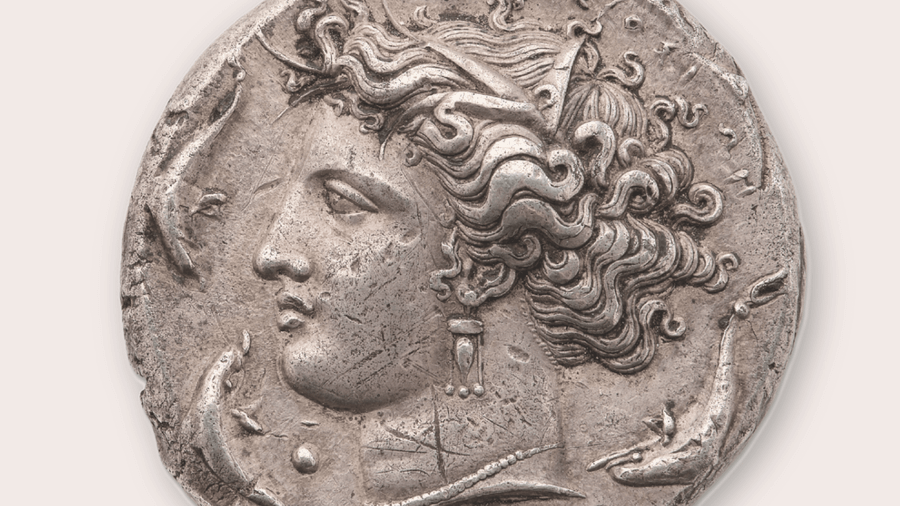
In Sicily, the magnificent decadrachm of Syracuse (lot 37 – est. €12,000 / €15,000), a masterpiece of Greek numismatics, celebrates the city’s glory under Dionysius the Elder. The galloping quadriga, crowned by Nike, and the head of Arethusa surrounded by dolphins embody both the power and identity of the city. The motif would be widely imitated, even by Carthaginian forces, as seen in lot 42 (tetradrachm – est. €1,800 / €2,300).
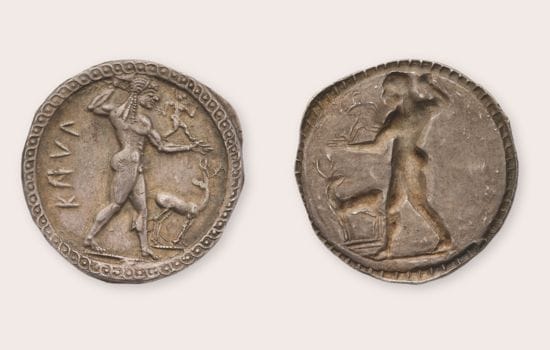
Further north, the Greek cities along the Calabrian coast began striking distinctive coins as early as the late 6th century BC, such as a stater from Caulonia (lot 28 – c. 525–500 BC, est. €5,000 / €6,000), notable for the clarity of its design and the purity of its archaic style.
The Language of Power in Roman Coinage
In Rome, coinage reached extraordinary levels of ideological effectiveness, particularly at the end of the Republic, amid political turmoil. Beyond dynastic rivalry and power struggles, Roman coinage offers a fascinating reflection of societal ideals.
The aureus of Julius Caesar (lot 63 – est. €3,000 / €4,000), struck in 46 BC, features the veiled head of Pietas, symbol of Roman tradition. The reverse, with the augur’s staff and sacrificial instruments, highlights Caesar’s dual religious and military authority.
His portrait also appears on denarii, such as one struck in 44 BC by Marcus Mettius (lot 211 – est. €2,000 / €3,000), where Caesar, holding the augur’s staff, is paired with Juno Sospita, protector of Rome. The association between Caesar and Rome’s tutelary deities underlines his appeal to ancient traditions to legitimise his power.
The aureus of Publius Clodius (lot 65 – est. €5,000 / €7,000), struck in 42 BC, combines the radiant head of the sun god Sol with a lunar reverse studded with stars, likely alluding to the deification of Julius Caesar that same year. Another aureus, struck for Gaius Vibius Varus (lot 66 – est. €4,000 / €5,000), pairs the laureate head of Apollo on the obverse with Venus holding a mirror on the reverse—figures invoking the Julian lineage and the divine legitimacy claimed by the triumvirs in their campaign against Caesar’s assassins.
This posthumous exaltation is also reflected in rare denarii: one struck in 42 BC by Publius Clodius (lot 222 – est. €2,000 / €2,500), depicting Caesar laureate on the obverse and Mars helmeted on the reverse, glorifies the late dictator’s political legacy; another, dated 38 BC (lot 148 – est. €5,000 / €7,000), features the facing profiles of the deified Caesar and Octavian as the son of a god.
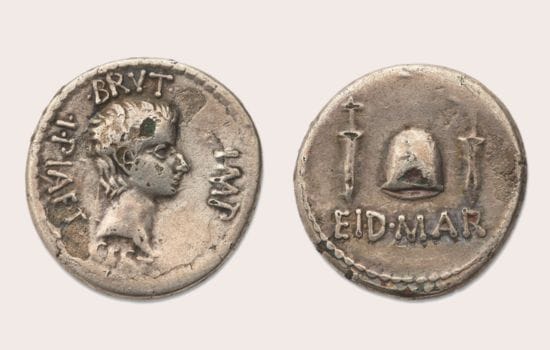
Lastly, the exceedingly rare denarius of Brutus (lot 226 – est. €8,000 / €10,000), boldly displays two daggers and a Phrygian cap—a spectacular political statement commemorating the Ides of March.