MARDI 27 MAI 2025 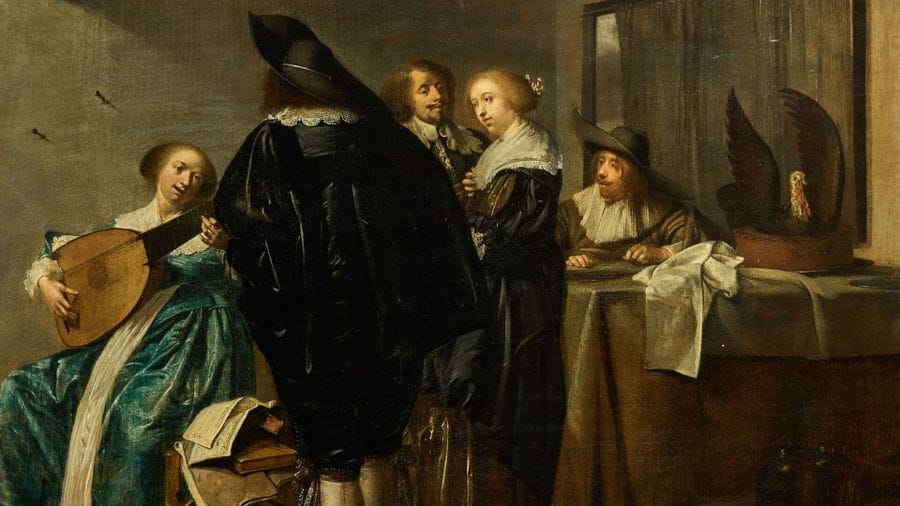
A rediscovered Dutch Golden Age painting
O n 27 May, the auction house Euvrard & Fabre will offer at Drouot a rediscovered work by Pieter Jacobsz Codde, appearing on the market for the first time since 1913.
Titled Concert in an Interior (est. €20,000 – €30,000), the painting is characteristic of the “merry company” scenes, a genre highly prized in 17th-century Dutch and Flemish painting. These compositions depict groups of men and women engaged in music-making, conversation or wine drinking — moments of refined sociability, often imbued with moral or amorous symbolism. When one or more figures are shown playing musical instruments, as in this work, the term “concert” or “musical gathering” is typically used.
Active in Amsterdam, Pieter Codde (1599–1678) established himself from the 1620s as one of the leading figures in this genre. In the wake of Willem Buytewech, and alongside artists such as Dirck Hals, Anthonie Palamedesz. and Willem Duyster, he developed a style marked by close attention to posture, clothing and interior atmosphere. These painters are often associated with the so-called “monochrome” trend, characterised by a restrained palette and refined treatment of light.
Codde’s paintings are typically small in scale and portray domestic scenes in which the elegance of the costumes matches the subtlety of observation. In Concert in an Interior, the scene unfolds in a carefully furnished room, and the protagonists’ attire suggests a certain ease. But far from the lively bustle often found in other merry company scenes, Codde here captures a quieter, more intimate moment of domestic joy — rendered with discretion and grace.
Also featured in the same sale is a group of nearly 80 works from the collection of the painter Albert Flocon (1909–1994). Born Albert Mentzel in Berlin, Flocon was a printmaker and theorist of perspective trained at the Bauhaus under the likes of Paul Klee and Josef Albers. He fled to Paris in 1933 to escape the rise of Nazism and later joined the French Resistance during the Second World War. After the war, he adopted the name of his ancestor Ferdinand Flocon and became a French citizen. A master of engraving — particularly burin engraving — he also pursued a profound theoretical exploration of perspective in art, through both his writings and his teaching at the Beaux-Arts in Paris.